Senbutsu Limestone Cave
As you progress through the cave, you can wash your feet in clear water while continuing your exploration, providing a thrilling adventure experience. Specifically, from about 480 meters in, there is a walking course through the water. This underground exploration is popular among a wide range of age groups, from children to the elderly. In addition to Senbutsu Cave, there are over 200 other caves in Hiraodai, such as Mejiro-do and Oshika-do, with Senbutsu Cave being the largest.
The total length of the tourist cave is 1.2 kilometers, and there are about 20 attractions within. As a staple summer spot and featured in a Google commercial, Senbutsu Cave captivates visitors with its mystical scenery and the allure of exploration.
Basic Information
- Spot Name
- Senbutsu Limestone Cave
- Location
- 〒803-0186 3-2-1 Hiraodai, Kokuraminami-ku, Kitakyushu, Fukuoka Prefecture, Japan
- Access
- Approximately 30 minutes from Kokura Station to Ishiwara-machi Station via the Hitahikosan Line. About 20 minutes by taxi from Ishiwara-machi Station.
- Parking
- 100 spaces (free)
- Business Hours
- Weekdays: 9:00 AM to 5:00 PM
Saturday, Sunday, and Holidays: 9:00 AM to 6:00 PM
*However, in autumn and winter, until sunset
*Entry受付 is until 30 minutes before closing time (for winter, entry受付 is until 4:15 PM) - Fees
- Adults: 900 yen, Junior High School Students: 600 yen, Elementary School Students: 500 yen, 4 years and older: 200 yen.
- Contact Information
- Phone Number:093-451-0368(千仏鍾乳洞事務所)
- Official Website
Map
Detailed Information
Senbutsu Stalactite Cave is a limestone cave located on the Hiraodai Plateau in Kokuraminami Ward, Kitakyushu, Fukuoka Prefecture. It lies on a steep slope at an elevation of approximately 300 meters at the southeastern edge of Hiraodai, overlooking the direction of Yukuhashi City. On December 24, 1935, it was designated a Natural Monument of Japan. It is the largest of the many caves found on Hiraodai and is known as a popular tourist attraction where visitors can not only admire beautiful stalactites but also enjoy the adventurous experience of walking through the underground water flowing inside the cave.
Hiraodai, where Senbutsu Stalactite Cave is located, is a karst plateau extending across southern Kitakyushu. A karst plateau is an area where limestone has been dissolved by rainwater and groundwater, creating distinctive landforms. Hiraodai is characterized by white, rounded limestone rocks scattered across grasslands. Because they resemble a flock of sheep, the landscape is known as “Yogunbaru,” meaning “sheep group field.”
Hiraodai is counted as one of Japan’s three major karst areas. Part of it has been designated a Natural Monument of Japan, and the plateau is also included within the Kitakyushu Quasi-National Park. The scenery created by its vast grasslands and limestone rocks takes on different appearances throughout the seasons.
It is said that nearly 200 caves, large and small, lie beneath Hiraodai. Among them, the best-known caves developed for public sightseeing are Senbutsu Stalactite Cave, Mejiro Cave, and Ojika Cave. Senbutsu Stalactite Cave is particularly large and is distinguished by its abundant groundwater and canyon-like interior scenery.
Stalactite caves form when rainwater and groundwater seep into limestone and gradually dissolve the rock over long periods of time. Rainwater becomes weakly acidic as it absorbs carbon dioxide from the atmosphere and soil, slowly dissolving the calcium carbonate that makes up limestone. As cracks in the rock gradually widen and passages for groundwater grow larger, caves and underground rivers are formed.
Senbutsu Stalactite Cave was also formed as rainwater falling on Hiraodai continued to dissolve the limestone over many years. Abundant groundwater still flows through the cave today, continuing to erode the walls and floor little by little. Senbutsu Stalactite Cave is a place where visitors can sense the ongoing workings of nature, as the cave continues to change under the influence of groundwater.
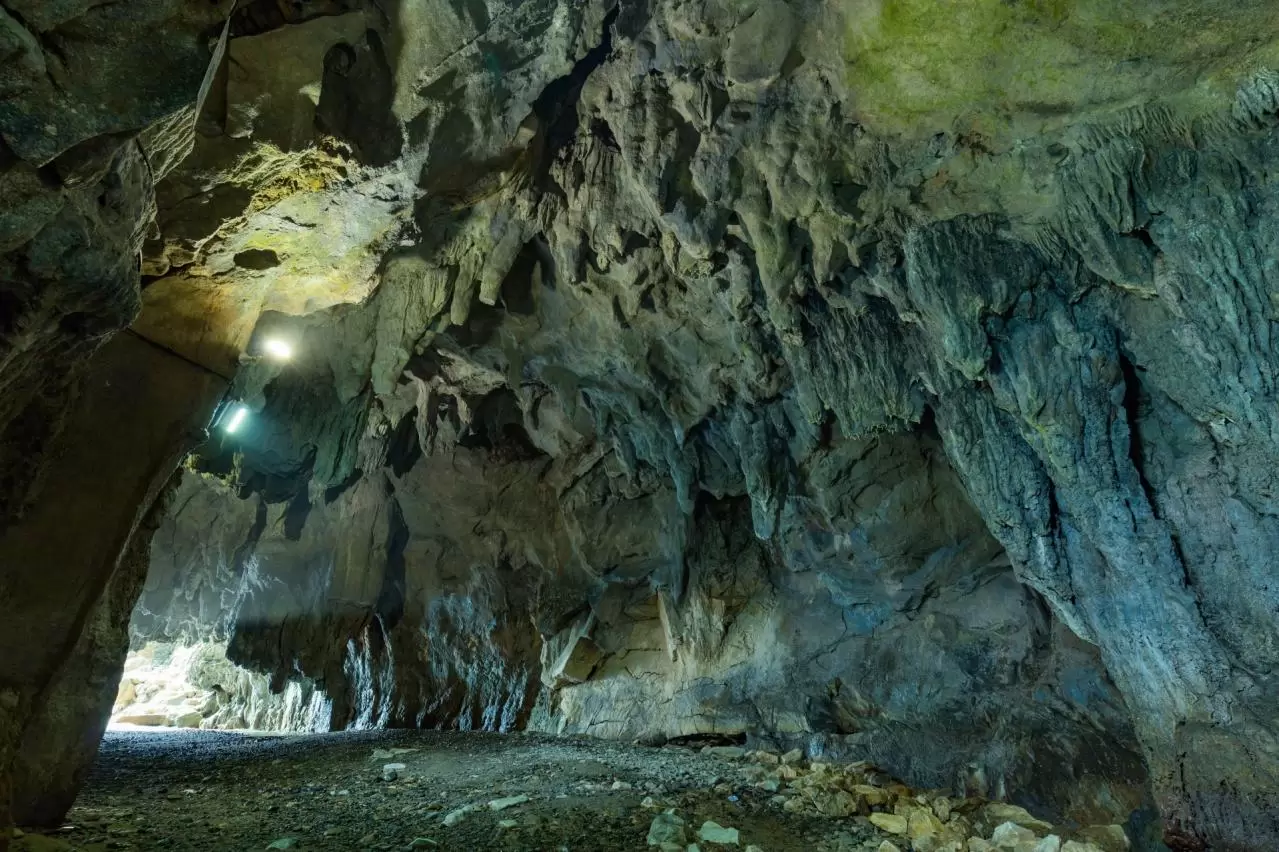
The total length of Senbutsu Stalactite Cave is said to reach several thousand meters, but lighting has been installed only up to approximately 900 meters from the entrance, which is the extent open to the general public. The cave winds northeastward and has a canyon-like structure, with narrow passages and high ceilings.
The cave reaches a maximum width of approximately 10 meters and a maximum ceiling height of around 15 meters. In some places, visitors move between dramatic, sheer rock walls. The surfaces smoothed and carved by groundwater and the intricately curving passages resemble a gigantic sculpture created by nature over countless years.
One of the representative attractions of Senbutsu Stalactite Cave is the approximately 30 stalactites of various sizes hanging at the cave entrance. The stalactites clustered beneath the ceiling create a powerful scene reminiscent of a curtain of rock. Even before entering the cave, visitors can sense a mysterious world unlike anything above ground.
Inside the cave, visitors can see not only stalactites but also stalagmites and columns. Stalactites form when calcium carbonate gradually precipitates from water containing dissolved limestone and grows downward from the ceiling. In contrast, when calcium carbonate accumulates from water dripping onto the floor and grows upward, the formation is called a stalagmite.
When stalactites and stalagmites meet after many years, they form a stone column resembling a single pillar. These formations require an extraordinarily long time to develop. Each drop of water leaves behind a tiny amount of mineral content, and the formations gradually grow over thousands or tens of thousands of years.
The complex rock shapes and patterns found inside the cave are natural formations created by the combination of rainfall, water flow, and the characteristics of the rock. Almost none have exactly the same shape, and each one tells the story of the passage of time over many years.
The temperature inside the cave remains around 16°C throughout the year, while the water temperature is approximately 14°C. During the hot summer months, the cave feels refreshingly cool, and many people visit it as a “natural air conditioner” and a place to escape the heat. Conversely, in winter, when the outside air is cold, the cave may feel warmer than outdoors.
The relatively small seasonal temperature variation is a characteristic of underground spaces. However, the water flowing through the cave remains cold even in summer, and visitors’ feet may become chilled when walking for a long time. During the colder seasons, it is advisable to bring a warm jacket.
The cave has high humidity, and water droplets may fall in some areas. Visitors are therefore advised to wear clothing that can get somewhat wet or dirty.
The greatest feature of Senbutsu Stalactite Cave is that after approximately 480 meters from the entrance, the route changes to one where visitors walk through a stream flowing underground. Ordinary shoes can be worn up to the point about 480 meters from the entrance. Beyond that, the area is called “Oku no Hosomichi,” or “the narrow path to the depths,” and visitors proceed with their feet immersed in clear underground water.
The water depth varies depending on the location and the amount of rainfall. Normally, the deepest sections reach to about below an adult’s knees, but when the groundwater level rises after rain, the water may reach above the knees. The flow and depth of the water are not always constant, so it is important to check the conditions on the day of your visit and avoid pushing yourself beyond your limits.
Walking between the rock walls through cold water offers an adventurous appeal unlike that of ordinary limestone cave sightseeing. The watercourse, where visitors proceed while splashing through the stream, is a unique attraction of Senbutsu Stalactite Cave that allows both children and adults to enjoy the feeling of being explorers.
Grass sandals and sandals are available for free rental at the site for visitors walking the watercourse. This allows visitors to keep their own shoes dry, but there are uneven rocks and slippery areas underfoot.
Those who prioritize ease of walking may wish to bring marine shoes or similar footwear with straps that secure the heels. Rental procedures and conditions of use may change, so it is advisable to check the current details on site when visiting.
Lighting is installed up to approximately 900 meters from the entrance. Walking from the entrance to the farthest illuminated point and returning along the same route generally takes around 40 minutes in total.
However, the time required varies depending on crowd levels, walking speed, water volume, and the amount of time spent taking photographs. During summer vacation, consecutive holidays, and other busy periods, many tourists visit, and waiting times may occur around the watercourse and parking area.
The passage inside the cave is unlike the flat pathways of a typical tourist facility. There are narrow sections, low ceilings, exposed rock surfaces, and areas where water flows, so visitors must proceed carefully while watching both their footing and the space above their heads. The fact that the cave retains its natural terrain is part of its appeal, but visitors must take sufficient care when walking.
For children, walking through the water and making their way through the complex cave can become a memorable experience that makes them feel like explorers. However, the water may feel deep to small children, and they may lose their footing on the rocks.
When visiting with children, guardians should remain close at all times and take safety precautions such as holding their hands. If a child is frightened or has difficulty walking, do not force them to continue deeper into the cave. Instead, enjoy the area near the entrance or the section accessible in ordinary shoes.
The area near the entrance can be enjoyed by visitors of many ages, but the route from the parking lot to the cave entrance includes slopes and stone steps going downhill. Since visitors must climb the same route on the way back, a certain level of physical fitness is required.
Older visitors and those who have concerns about their legs or lower back should adjust the area they visit according to their physical strength and condition. Walking sticks may sometimes be available on site, but slippery areas exist along the watercourse, so safety should take priority and visitors should not overexert themselves.
When groundwater levels rise after heavy rain or similar weather, the water may be deeper than usual. For safety reasons, the cave may also be closed or the area available for viewing may be restricted.
Before visiting, it is advisable to check not only the weather forecast but also the official website or telephone announcements for the operating status and conditions inside the cave.
The name “Senbutsu Stalactite Cave” is said to have originated from a temple called Senbutsuin that once stood nearby. Senbutsuin is believed to have been a branch temple associated with Eizan Ganko-ji Temple in Yukuhashi City, which tradition says was founded by Gyoki, a Buddhist monk of the Nara period.
Senbutsuin is said to have once flourished with a full complex of seven major temple buildings, but it was destroyed by fire during the wars of the Sengoku period and subsequently abandoned. Although the temple itself no longer remains, its name has been passed down to the limestone cave.
The area around Senbutsu Stalactite Cave contains a variety of natural scenery and tourist facilities characteristic of Hiraodai. Above ground, visitors can enjoy Yogunbaru, where white limestone rocks spread across the grasslands, as well as highland scenery that changes with the seasons.
In spring, fresh greenery sprouts after the controlled burning of the grasslands. In summer, vivid green fields spread across the plateau. In autumn, Japanese pampas grass sways in the wind, while winter offers quiet and peaceful highland scenery. Hiraodai’s above-ground karst landscape is just as appealing as the underground world of the cave.
Nearby is Hiraodai Nature’s Village, where visitors can enjoy nature observation and hands-on activities. In addition to walking while taking in views of the expansive grasslands, visitors may be able to participate in activities such as pottery making and soba noodle making, depending on the season.
By combining Senbutsu Stalactite Cave with Hiraodai Nature’s Village, visitors can enjoy both the limestone cave beneath the ground and the karst plateau above it in a single day.
Hiraodai is also home to Mejiro Cave and Ojika Cave, in addition to Senbutsu Stalactite Cave. Each cave has different formations and interior scenery, so visitors with sufficient time and energy may enjoy touring them comparatively.
Operating conditions and activities vary from facility to facility and may change depending on the weather. Those planning to visit are advised to check the latest information for each facility in advance.
There are shops and dining facilities near the entrance to Senbutsu Stalactite Cave. After exploring the cave, visitors can enjoy coffee brewed with water from Hiraodai and the local specialty known as “karst manju.”
Karst manju is also popular as a souvenir or a memento of a cave visit. Products and opening hours may change, so please check the information provided locally.
Traveling to Senbutsu Stalactite Cave by car is convenient. It takes approximately 20 minutes by car from the Kokuraminami Interchange on the Kyushu Expressway, or about 20 minutes by taxi from Ishiharamachi Station on the JR Hitahikosan Line.
Free parking is available, but the area may become crowded during summer vacation, on Saturdays, Sundays, public holidays, and consecutive holidays. Travel time may also increase depending on road conditions, so visitors are advised to allow plenty of time.
The standard opening hours are from 9:00 a.m. to 5:00 p.m. on weekdays and from 9:00 a.m. to 6:00 p.m. on Saturdays, Sundays, and public holidays. However, in autumn and winter, the facility may operate only until sunset, and admission to the cave closes earlier than the official closing time.
Opening hours may change depending on the season and weather, so check the latest information before visiting. Admission fees are reportedly payable in cash only, so it is advisable to bring cash.
Clothing that allows easy movement and can get somewhat wet or dirty is most suitable. When walking the watercourse, trouser hems may become wet, so clothing with hems that can be rolled up easily, or shorter trousers, is convenient.
Water droplets may fall inside the cave, and some areas of the floor may be slippery. Long skirts and loose, wide hems are best avoided, as they can easily come into contact with rocks or water and make walking more difficult.
When using a smartphone or camera, visitors should take care to prevent them from being submerged or dropped. Preparing a waterproof case or a neck strap can make photography safer and more enjoyable.
Inside the cave, visitors must not touch, damage, or take away stalactites, stalagmites, or other cave formations without permission. Because stalactites take an extremely long time to form, once they are damaged, it takes an immense amount of time for them to return to their original condition.
To preserve this precious natural environment, protected as a Natural Monument of Japan, for future generations, visitors should follow the information provided on site and the instructions of staff members.
Senbutsu Stalactite Cave is not simply a tourist cave where visitors look at stalactites. By feeling the cool air, walking between the rock walls, and proceeding while experiencing the chill of the underground water, visitors can experience with their entire bodies the natural processes unfolding beneath Hiraodai.
The stalactites hanging at the entrance, the canyon-like interior, and the underground water that continues to flow today combine to create a mysterious world completely different from the surface.
The cave is recommended not only for people seeking a cool summer destination, but also for those interested in nature and geology, families who want to enjoy an adventure with their children, and anyone looking for a destination unlike a conventional tourist facility.
Offering both landscapes shaped by nature over immense spans of time and the unique experience of walking through underground water, Senbutsu Stalactite Cave is one of Hiraodai’s most representative tourist attractions.
Senbutsu Limestone Cave Movies


![[北九州市平尾台 千仏鍾乳洞]真夏に最適スポット鍾乳洞に行ってきました。 #平尾台#鍾乳洞#北九州市](https://i.ytimg.com/vi/pPT5nHh-kE0/mqdefault.jpg)


Fukuoka Tourist Attractions
View List
Mojiko Retro
Moji Port Retro is an attractive district in Kitakyushu City. This port town, which flourished from the Meiji era to the early Showa period, was once counted among J...

BOSS E・ZO FUKUOKA
In July 2020, "BOSS E・ZO FUKUOKA" opened next to the Fukuoka PayPay Dome. This seven-story facility is known for its breathtaking attractions and state-of-the-art e...

Kyushu National Museum
The Kyushu National Museum is the fourth national museum in Japan, following those in Tokyo, Kyoto, and Nara. It opened in 2005 in Dazaifu City, Fukuoka Prefecture. ...

Marine World Uminonakamichi
"Marine World Uminonakamichi," which reopened in 2017, is an aquarium themed around the seas of Kyushu. It features over 30,000 marine organisms from 350 species, re...

Ohori Park
Ohori Park is an oasis in Fukuoka City, utilizing the outer moat of Fukuoka Castle, covering an expansive area of approximately 40 hectares. It can be accessed in ju...

Sakurai Futamigaura
Sakurai Futamigaura is located in Itoshima City, Fukuoka Prefecture, and is a beautiful scenic spot within the Genkai Quasi-National Park. Known as "Futamigaura of t...

Canal City Hakata
Canal City Hakata opened in 1996 with the concept of "Theater of the City" and has become Japan's first full-scale commercial complex that creates a new flow of peop...

Kushida Shrine
Kushida Shrine is known as the guardian shrine of Hakata and is affectionately referred to by locals as "O-Kushida-san." It has a long history and the current shrine...