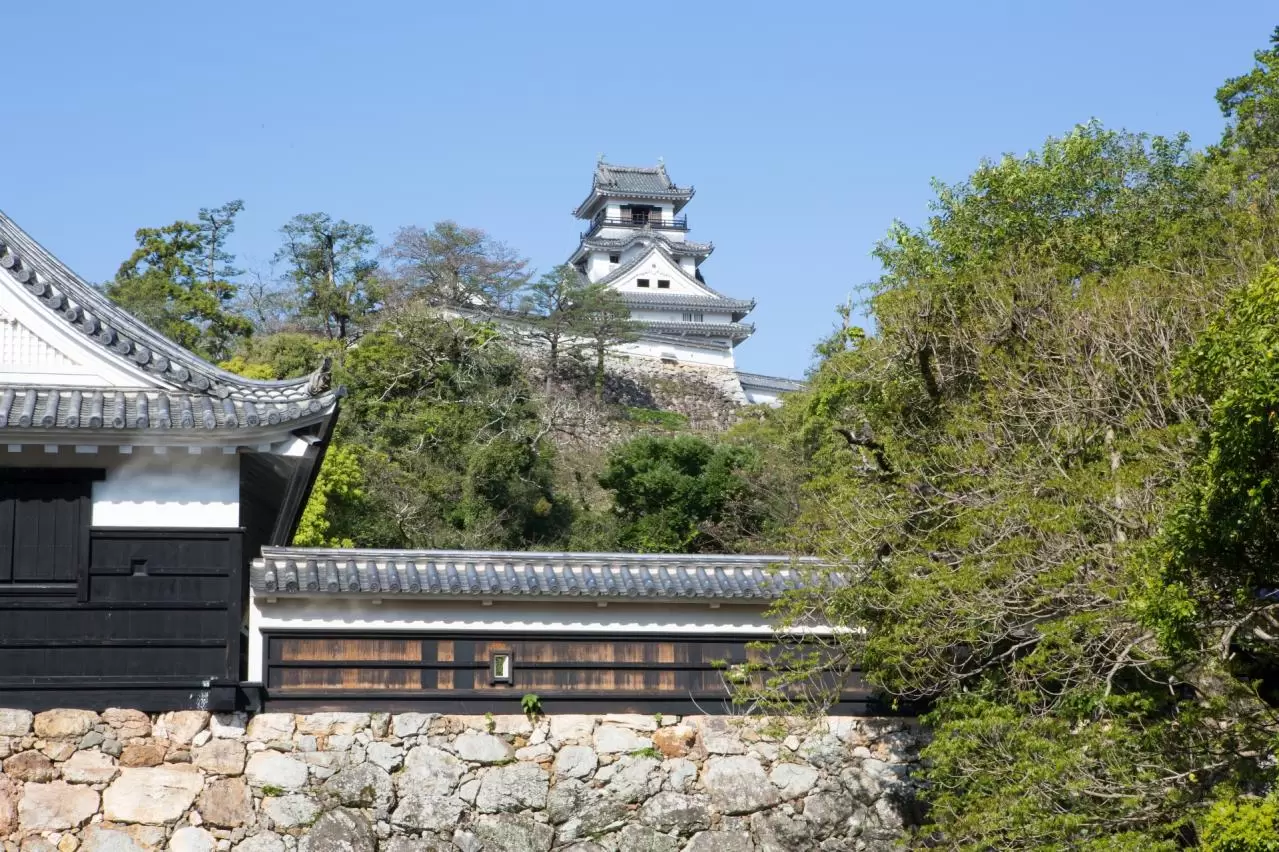
Kochi Castle
In 1727, a large fire in the castle town destroyed most of the structures, but by 1753, it had been reconstructed to its original beautiful form. Kochi Castle is the only castle in Japan that has its main keep, palace, and buildings from the Edo period still extant, making it of great historical value.
Kochi Castle is also known as "Taka Castle" because its beautiful white walls and gray tiled roofs resemble hawk feathers. The castle is built on the approximately 44-meter-high Takasaka Mountain, with the Kagamigawa and Enokuchi rivers functioning as its outer moats.
Within the castle, there are the main keep and the Honmaru Palace (Kaidokukan), which are recognized as important cultural properties of the country. There are also statues of Chiyo, the wife of Yamauchi Kazutoyo, and of Itagaki Taisuke, adding many historical elements to the site.
Having been built more than 400 years ago and rebuilt over 250 years ago, Kochi Castle continues to shine with its beautiful appearance and historical significance. Located in the center of Kochi City, it attracts tourists and history enthusiasts alike. This castle remains a captivating place for many, allowing visitors to feel the essence of Japan's history and culture.
Kochi Castle Movies


Basic Information
- Spot Name
- Kochi Castle
- Location
- 〒780-0850 1-2-1 Marunouchi, Kochi Park, Kochi City, Kochi Prefecture
- Access
- From Kochi JR Station, take the Tosaden Kotsu Sanbashi Line bound for Sanbashidori 5-chome for 5 minutes. Transfer at Harimaya Bridge to the Tosaden Kotsu Ino Line heading towards Ino for 4 minutes, then get off at Kochi Castle front and walk for 10 minutes.
- Parking
- Kochi Park Parking Lot (Paid)
- Business Hours
- 9:00 AM to 4:30 PM (last admission at 5:00 PM)
- Regular Holiday
- New Year's holiday period
- Fees
- Adults: 420 yen
Free for high school students and below
Group discount available (for 20 or more people) - Contact Information
- Phone Number:088-823-9112
- Official Website
Map
Detailed Information
Kochi Castle, located in the center of Kochi City in Kochi Prefecture, is one of Japan’s most celebrated surviving castles. After Yamauchi Kazutoyo, who distinguished himself in the Battle of Sekigahara, was granted the entire Tosa domain—valued at 240,000 koku—by Tokugawa Ieyasu, he began construction of the castle in 1601. It was completed in 1611. The castle was built on the site of Otakasa Castle, which had existed during the Nanboku-cho period. The Yamauchi family ruled the Tosa domain for approximately 260 years, across 16 generations, until the Meiji Restoration.
In 1727, a major fire in the castle town destroyed nearly all of the buildings except the Otemon Gate. Reconstruction began in 1729, and by 1753 the castle had been rebuilt to closely resemble its original appearance. It subsequently survived numerous threats, including the 1873 edict abolishing castles and the Pacific War, and its historic buildings remain in remarkably good condition today. Because of its graceful appearance, Kochi Castle is also known as “the finest castle in the Nankaido region.”
Kochi Castle is one of Japan’s only 12 surviving original castle keeps. It also holds exceptional historical value as the only castle in Japan where an Edo-period keep, the honmaru palace—known as Kaitokukan—and the other buildings of the main bailey have survived together as an integrated complex. Fifteen structures, including the keep, the honmaru palace, and the Otemon Gate, have been designated Important Cultural Properties of Japan. Only three castles in Japan—Kochi Castle, Marugame Castle, and Hirosaki Castle—retain both their original Otemon Gate and castle keep. The view of the keep framed beyond the Otemon Gate is one of Kochi Castle’s most popular photographic scenes.
The keep is a watchtower-style structure with three stories on the exterior and six floors inside. From the top floor, visitors can enjoy a 360-degree panorama encompassing Kochi City, the Kagami River, and distant mountains. Inside the keep, steep staircases, massive beams, and other features preserve Edo-period construction techniques. The honmaru palace showcases beautiful designs and defensive features, including the “divided waves” ranma transom, which depicts the rough seas of Tosa, as well as hidden chambers for warriors.
Although Kochi Castle was never used in actual battle, it was built with defense as a priority. The keep and Otemon Gate retain numerous features characteristic of castles from the Warring States period, including ishiootoshi openings for dropping stones onto attackers, sama loopholes for firing arrows and guns, and shinobi-gaeshi, or anti-climbing spikes—one of the few surviving examples in Japan. The Tsumemon, a bridge corridor connecting the honmaru and ninomaru baileys, is also known for being the only surviving structure of its kind in Japan that spans a dry moat.
The castle’s stone walls are another highlight. Most were built using nozura-zukuri, a technique that uses naturally shaped stones, providing excellent drainage and durability. In the sannomaru bailey, visitors can also see beautiful uchikomi-hagi stonework, in which roughly shaped stones are fitted closely together, offering an up-close look at the advanced masonry techniques of the time.
Kochi Castle is also known by the nickname “Takajo,” or “Hawk Castle.” The name comes from the way the white walls finished with Tosa plaster and the gray roof tiles resemble the beautiful plumage of a hawk. In 2014, the castle was recognized by the Night View Tourism Convention & Bureau as one of Japan’s “Three Great Night Castles.” At night, the keep is illuminated, and projection mapping is presented during special events, creating a fantastical appearance unlike its daytime scenery.
Within the castle grounds stand statues of Yamauchi Kazutoyo, the founder of the castle, and his wife, Chiyo, who is renowned for her support of her husband, as well as a statue of Itagaki Taisuke, a leader of the Freedom and People’s Rights Movement. These landmarks offer insight into the history of Kochi Prefecture. Located just beside the castle, the Kochi Castle History Museum displays historical documents and fine arts and crafts associated with the Yamauchi family. Its observation area, offering a panoramic view of Kochi Castle and the Otemon Gate, is also popular.
In front of the Otemon Gate, the Sunday Market is held every week and has a history of more than 300 years. Visitors can enjoy fresh local vegetables, regional cuisine, and specialty products unique to Kochi. With its rich historical significance, beautiful keep, defensive structures, stone walls, nighttime scenery, and surrounding attractions, Kochi Castle is one of Kochi Prefecture’s foremost tourist destinations. As a valuable cultural heritage site that conveys Japan’s castle culture and the history of Tosa to the present day, it continues to attract visitors from around the world.
Kochi Tourist Attractions
View List
Hirome Market
Hirome Market is located in the heart of Kochi City, just a 2-minute walk from Kochi Castle. Opened in 1998, this market is named after "Hiroto Fukao Banken," a high...

Harimaya Bridge
Harimaya Bridge is a sightseeing spot in Kochi, celebrated in the "Yosakoi Bushi" song, and is the setting for the love story of the monk Junshin and his daughter Ou...

Katsurahama
Katsurahama is a representative tourist spot in Kochi Prefecture, known since ancient times as a famous moonlit location celebrated in the "Yosakoi Bushi" folk song....

Kochi Prefectural Sakamoto Ryoma Memorial Museum
The Kochi Prefectural Sakamoto Ryoma Memorial Museum is a place that displays valuable historical materials related to Sakamoto Ryoma, showcasing his personality, ac...

Ryugado Cave
Ryugadō is one of Japan's representative limestone caves, formed over approximately 175 million years, with a total length of around 4 kilometers. It is located in K...

Ashizuri Misaki
Cape Ashizuri is located at the southernmost tip of Shikoku, offering a panoramic view of over 270 degrees from its observation deck. Situated at the tip of the Ashi...

Sadachine Bridge
Sada Shinkai Bridge is the longest and most downstream sunken bridge spanning the Shimanto River in Kochi Prefecture, with a length of approximately 300 meters. This...

Kitagawa Village "Mone no Niwa" Marumottan
Kitagawa Village's "Monet's Garden Marmottan" is a beautiful garden that is the only official recreation of the Impressionist painter Claude Monet's garden located i...