Marugame Castle
Marugame Castle Movies


Basic Information
- Spot Name
- Marugame Castle
- Location
- 〒763-0025 1 Bancho, Marugame City, Kagawa Prefecture, Japan
- Access
- 10-minute walk from Marugame Station on the JR Yosan Line
Approximately 10 minutes by car from Zenzoji IC
Approximately 12 minutes by car from Sakaide IC - Parking
- 50 cars
- Regular Holiday
- Main Keep: Open all year round; Ote Ichinomon: Closed on rainy days.
- Fees
- Main keep only:
Adults 400 yen, Children (elementary and junior high school students) free. - Contact Information
- Phone Number:0877-22-0331
- Official Website
Map
Detailed Information
Marugame Castle is a hirayama-style castle built on Mount Kameyama, which rises approximately 66 meters above sea level in the center of Marugame City, Kagawa Prefecture. It is also known as Kameyama Castle. With a history spanning more than 400 years since its construction, the castle is renowned as a valuable historic site, featuring one of only 12 surviving original wooden castle towers in Japan. It has also been selected as one of Japan’s “Top 100 Castles” by the Japan Castle Foundation, and is cherished by many as one of Kagawa Prefecture’s leading historical attractions.
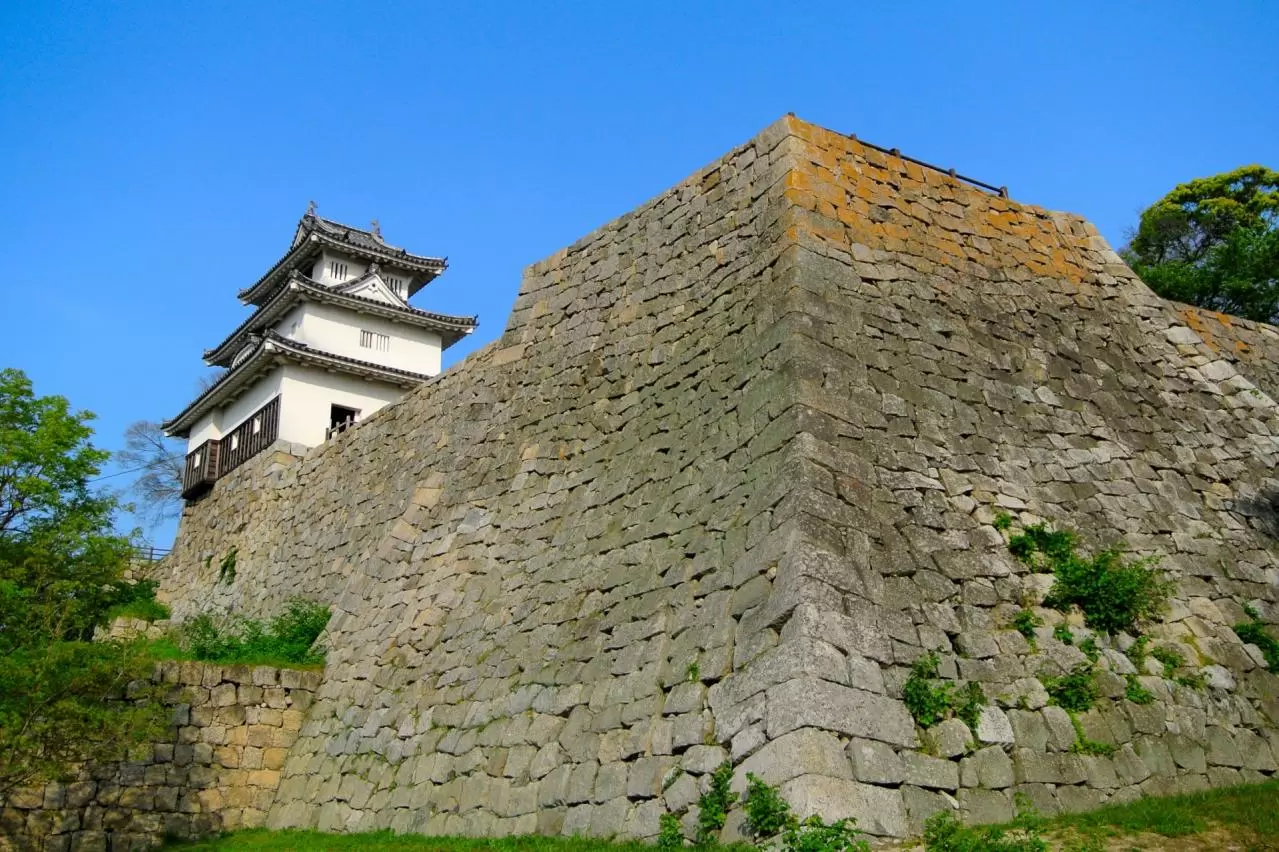
The most distinctive feature of Marugame Castle is its magnificent stone walls, for which it is known as “the castle of stone walls.” The stone walls rise in stages from the inner moat to the main bailey, reaching a total height of approximately 60 meters. The castle is famous for having the tallest stone walls in Japan when measured by their total height. Particularly striking is the elegant curve known as the “fan-shaped slope,” seen in the tall stone walls. The lower sections have a gentle incline that gradually becomes steeper toward the top, creating a graceful, sweeping curve. The striking scenery formed by the white castle tower and massive stone walls is breathtaking, and the castle is also highly regarded for its beauty, which harmonizes with the changing seasons, including cherry blossoms in spring and autumn foliage.
## The History of Marugame Castle
The history of Marugame Castle is believed to date back to the Muromachi period, but it was developed into a full-scale castle during the final years of the Sengoku period. In 1597, Ikoma Chikamasa, who ruled Sanuki Province, and his son, Ikoma Kazumasa, began construction of the castle as a branch castle of Takamatsu Castle. At the time, Marugame Castle was a large-scale fortification that employed a comprehensive defensive layout known as a “sogamae,” in which not only the castle itself but also the entire castle town was enclosed by moats and earthen ramparts.
However, in 1615, the Tokugawa shogunate issued the “One Province, One Castle Order.” The Ikoma clan retained its main castle, Takamatsu Castle, and Marugame Castle was abandoned. Later, the Ikoma clan was dispossessed following a family dispute, and in 1641, Yamazaki Ieharu entered the domain as the lord of Marugame.
With the shogunate’s permission, Yamazaki Ieharu began rebuilding Marugame Castle in 1643. Known as a master castle builder who had also worked on Osaka Castle and Edo Castle, he employed advanced stone-wall construction techniques at Marugame Castle. However, he died in 1648, midway through the project, and never saw its completion.
In 1658, Kyogoku Takakazu entered the domain as the lord of Marugame and took over the construction work. The castle tower that survives today was completed during the rule of the Kyogoku clan, which governed the Marugame Domain for approximately 200 years, until the Meiji Restoration.
After the Meiji Restoration, the castle lost its official role following the Castle Abolition Ordinance of 1873, and many structures, including turrets and connected buildings, were demolished. However, major structures such as the castle tower and main gates were preserved. Today, the entire castle site has been developed as a historic park and serves as a place of relaxation for local residents and visitors.
## The Smallest of Japan’s Twelve Original Castle Towers
The castle tower of Marugame Castle is one of Japan’s 12 surviving original castle towers and has been designated an Important Cultural Property of Japan. It is a three-tiered, three-story wooden structure standing approximately 15 meters tall.
Although it is the smallest of Japan’s surviving castle towers, it is exceptionally beautiful, with a well-proportioned exterior. Its roof features elegant curved gables known as karahafu, as well as triangular chidori hafu gables. Despite its small scale, the tower incorporates refined and dignified architectural details.
The castle tower was built as part of the reconstruction project that began in 1643 and is believed to have been completed around 1660. Steep staircases and defensive features remain inside, conveying the character of castle architecture from the Edo period. From the top floor, visitors can enjoy panoramic views of Marugame City, the Seto Inland Sea, and the Sanuki Plain, making it a popular scenic viewpoint.
## Japan’s Tallest Stone Walls
The stone walls are an essential part of the story of Marugame Castle. Built in stages around the natural terrain of Mount Kameyama, the walls extend through the main, second, and third baileys, creating a spectacular sight and reaching a total height of approximately 60 meters.
Various stonework techniques were used in the walls, allowing visitors to observe the evolution of construction methods over different periods:
- Nozurazumi, in which natural stones are stacked largely as they are
- Uchikomi-hagi, in which roughly shaped stones are fitted together
- Kirikomi-hagi, in which precisely cut stones are laid with minimal gaps
- Sangi-zumi, a technique used to reinforce the corners of the walls
The tall stone walls on the northern side of the third bailey exceed 20 meters in height and are regarded as one of the finest achievements of early Edo-period stone-wall construction.
The main bailey also retains a rare structure known as habaki stone walls, which were built to reinforce the existing walls.
## The Main Gates
Marugame Castle retains Ote Gate I, also known as Taiko Gate, and Ote Gate II, both of which have been designated Important Cultural Properties of Japan.
### Ote Gate I (Taiko Gate)
This imposing gate is built in the turret gate style. In the past, a drum inside the turret was used to announce the time, which is why it is also known as Taiko Gate. In 2006, the time drum was revived and is still struck at noon each day, making it popular with visitors.
### Ote Gate II
This gate is built in the korai-mon style. Between it and Ote Gate I is a square-shaped enclosure known as a masugata, which was designed to prevent enemy intrusions. It is a valuable surviving feature that allows visitors to see the defensive ingenuity of castle construction up close.
## The Second and Third Baileys
The second bailey was the final defensive stronghold protecting the main bailey and has now been developed as an open plaza. In spring, cherry trees bloom in abundance, making Marugame Castle one of Kagawa Prefecture’s renowned cherry-blossom viewing spots.
The second bailey also contains a deep well said to be more than 30 meters deep. It is famous as one of the deepest castle wells in Japan.
The third bailey is a large fortified enclosure surrounding the main and second baileys. In the past, it was lined with turrets, including the Tsukimi Turret, the Kon Turret, and the Inui Turret. Magnificent stone walls still remain today, allowing visitors to appreciate the castle’s formidable defensive capabilities.
## The Legend of Hasaka Juzaburo
A legend associated with the stonemason Hasaka Juzaburo has been passed down at Marugame Castle.
When the castle lord praised the completed stone walls, Juzaburo reportedly said, “I could easily climb them with just an iron bar,” and demonstrated by climbing the walls himself. Fearing that the enemy might make use of this ability, the lord is said to have ordered him to work on a well and then had him killed inside it. This tragic story has remained part of the castle’s lore.
Although it is unclear whether the story is historically accurate, it continues to be told as a legend symbolizing the difficult work that went into completing Marugame Castle.
## Marugame Castle Today
Today, Marugame Castle is preserved as a historically significant castle site while also serving as a beloved place of relaxation for local residents. Cherry blossoms adorn the grounds in spring, lush greenery covers them in summer, and autumn foliage adds color in fall. In winter, the castle tower and stone walls stand out beautifully against the crisp, clear air, attracting many visitors throughout the year.
With Japan’s tallest stone-wall complex, the smallest surviving original wooden castle tower among Japan’s twelve original towers, and more than 400 years of history and culture, Marugame Castle is one of the finest historic castles to visit in Kagawa Prefecture.
Kagawa Tourist Attractions
View List
Kankakei Ropeway
The Kankakei Ropeway is a cable car that leads to the summit of Kankakei, located within the Setonaikai National Park. Kankakei is counted among Japan's three great ...

Chichibu Shore
"Chichibugahama" in Mitoyo City, Kagawa Prefecture, is a seaside resort known for its approximately 1 km long beach and beautiful sunsets. During low tide, the water...

Ritsurin Garden
Ritsurin Park is a vast daimyo garden located in Takamatsu City, and its charm is immeasurable. The flat area alone spans 16.2 hectares, and when including Mount Shi...

Seto Ohashi Memorial Park
Seto Ohashi Memorial Park is a seaside park located in an ideal spot with a close view of the Seto Ohashi Bridge. Within the park, there is a memorial hall where vis...

Kotohira Shrine
Konpira Shrine, commonly known as "Sanuki Konpira-san," is a sacred place located on the slopes of Mount Zoto. This shrine is revered as the deity of the sea and is ...

Michi-no-Eki "Shodoshima Olive Park"
The "Shodoshima Olive Park" roadside station is located on a small hill that offers a panoramic view of the Seto Inland Sea. It is a Mediterranean-themed spot featur...

Shiseki Takamatsu Castle Ruins and Tamamo Park
Takamatsu Castle Ruins and Tamamo Park, designated as a national historic site, is a park that has been developed around the remains of Takamatsu Castle, which serve...

Angel Road
Angel Road is a romantic spot located on Shodoshima Island, featuring a sandy path that only appears during low tide, twice a day. This path connects four islands, a...