Shoka Sojuku
Shoka Sojuku Movies


Basic Information
- Spot Name
- Shoka Sojuku
- Location
- 〒758-0011 1537 Tsubaki-Higashi, Hagi City, Yamaguchi Prefecture, Japan
- Access
- 15 minutes on foot from Higashi-Hagi Station on the JR San'in Line.
- Parking
- Parking available.
- Business Hours
- Free to visit (exterior only)
- Regular Holiday
- None
- Fees
- Free
- Contact Information
- Phone Number:0838-22-4643
- Official Website
Map
Detailed Information
Shoka Sonjuku is a private academy in Hagi, Yamaguchi Prefecture, renowned as one of the leading educational institutions of the late Edo period. It is widely known for having been led by Yoshida Shoin, a thinker and educator of the late Edo period. The academy still stands today within the grounds of Shoin Shrine and was registered as a UNESCO World Cultural Heritage Site in 2015 as part of the “Sites of Japan’s Meiji Industrial Revolution: Iron and Steel, Shipbuilding and Coal Mining.” It holds tremendous importance in modern Japanese history as the place where many of the activists who played key roles from the final years of the Edo period through the Meiji Restoration were educated.
The origins of Shoka Sonjuku date back to 1842, when Yoshida Shoin’s uncle, Tamaki Bunnoshin, opened a private school in his home to educate children and young disciples. At the time, the area was known as Matsumoto Village, which gave the academy its name, “Shoka Sonjuku.” Later, when Tamaki Bunnoshin became busy with his official duties, the school was taken over by Kubo Gorozaemon, Shoin’s maternal great-uncle, who continued educating young people from the local community.
Yoshida Shoin began to lead Shoka Sonjuku in earnest after 1855. Deeply concerned about the threat posed by foreign powers following Commodore Perry’s arrival in Japan, Shoin attempted to stow away aboard one of the foreign ships anchored off Shimoda, Izu, in order to study conditions overseas. However, his plan failed. After being held at the Tenmacho Prison in Edo, he was sent to Noyama Prison in Hagi. He was subsequently placed under house arrest at his family home, the Sugi residence.
While under confinement, Shoin began giving lectures to his family and relatives in his room. As word of his teaching spread, young people from the surrounding area also began to gather. This marked the beginning of the Shoka Sonjuku later led by Shoin.
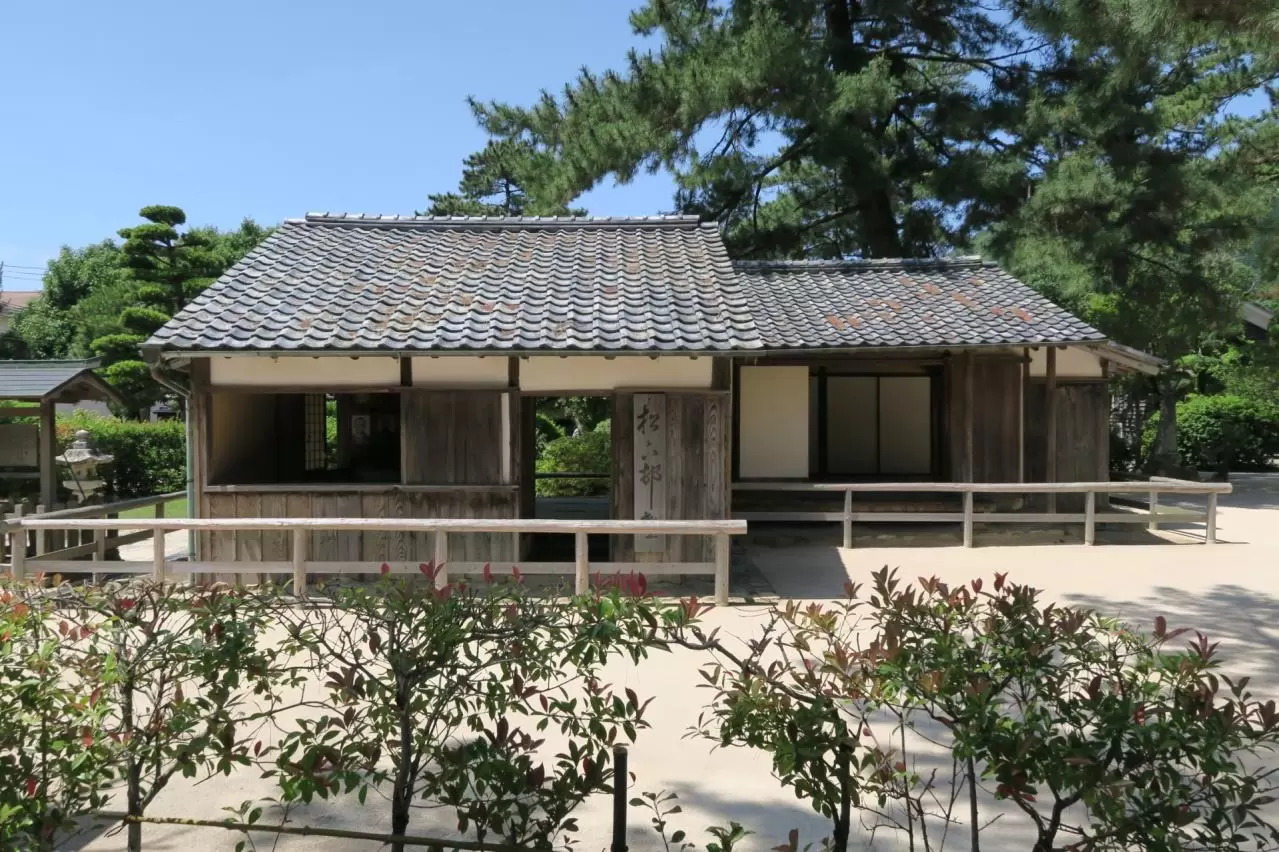
As the number of students increased, one room in the Sugi residence became too small. In 1857, a hut on the Sugi family property was renovated and used as the school building. The structure is a small, single-story wooden building with a tiled roof, measuring approximately 50 square meters. In addition to the original eight-tatami lecture room, Shoin later added a four-and-a-half-tatami room and a small three-tatami room. The building has been preserved to this day and retains a strong sense of its original appearance. The lecture room contains a plaster statue and portraits of Yoshida Shoin, as well as desks and other items, allowing visitors to experience the atmosphere of the late Edo period.
Shoin’s educational philosophy was highly progressive for its time. He accepted students regardless of social status or class and placed great emphasis on free discussion. The academy opened its doors not only to samurai but also to young people from a wide range of backgrounds, seeking to develop each student’s individual talents and character. Rather than mere memorization of knowledge, Shoin emphasized considering such questions as “How should one live?” and “What should one do for the sake of the nation?” The *Record of Shoka Sonjuku* contains the words, “Learning means learning what it means to be human,” expressing his belief in the importance of cultivating one’s character and establishing a personal mission through education.
At Shoka Sonjuku, students studied a wide range of subjects, including Confucianism, military science, history, politics, and national defense. In addition to lectures, lively discussions were held among the students, enabling them to deepen their learning by inspiring and challenging one another. Shoin was keenly aware of the threat posed by the Western powers and believed that Japan needed to develop Western technology, military science, and industry in order to become a modern nation. He therefore also taught the importance of coastal defense and technological innovation. These ideas had a profound influence on Japan’s subsequent modernization.
Shoka Sonjuku produced many figures who later became central to the Meiji Restoration and the construction of modern Japan. Notable students included Takasugi Shinsaku, Kusaка Genzui, Ito Hirobumi, Yamagata Aritomo, Yamada Akiyoshi, Shinagawa Yajiro, and Maebara Issei. Ito Hirobumi later became Japan’s first prime minister, while Yamagata Aritomo helped lay the foundations of the modern Japanese army. The academy’s graduates promoted Japan’s modernization in a wide range of fields, including politics, the military, and education. Shoka Sonjuku is thus often referred to as “the birthplace of the Meiji Restoration.”
However, Shoin’s period as head of the academy was by no means long. In 1858, the shogunate launched the Ansei Purge, and Shoin was imprisoned once again for reasons including his criticism of the shogunate’s policies. In 1859, he was executed at the Tenmacho Prison in Edo at the young age of 30. Shoin’s actual period of teaching at Shoka Sonjuku is believed to have lasted only about two and a half years. Nevertheless, his ideas and educational principles inspired many young people and became a driving force that dramatically changed the course of Japanese history.
After Shoin’s death, Shoka Sonjuku was carried on by his students and associates. The academy is believed to have continued until around 1892, reopening and closing several times along the way. It was later recognized for its historical value and is now designated as a national historic site.
Today, Shoka Sonjuku is preserved within the grounds of Shoin Shrine in Hagi, Yamaguchi Prefecture, and attracts many visitors from across Japan as a sacred place for history enthusiasts and admirers of the late Edo period. The interior of the building may be open to the public, particularly on weekends and public holidays, allowing visitors to see the former lecture room and historical exhibits. Its designation as a World Heritage Site has also increased international interest, and it is highly regarded as a place that can be considered the starting point of Japan’s modernization.
Yamaguchi Tourist Attractions
View List

Tsunoshima Bridge
The Tsunoshima Bridge, located in Shimonoseki City, Yamaguchi Prefecture, is one of Japan's most beautiful bridges, having opened in 2000. Spanning a total length of...

Hagi Castle Town
Hagi Castle Town is a historic area that developed around Hagi Castle, which was built by Mori Terumoto in 1604. This town retains a strong atmosphere of the Edo per...

Akiyoshi Cave
Akiyoshido Cave, located in Mine City, Yamaguchi Prefecture, is one of Japan's largest limestone caves, extending 100 meters underground within Akiyoshidai Quasi-Nat...

Kintaikyo Bridge
One of Japan's three famous bridges, the Kintai Bridge, is a wooden five-arch bridge measuring approximately 193.3 meters in length, located in Iwakuni City, Yamaguc...

Akiyoshi Cave
Akiyoshidai, one of Japan's largest karst plateaus, is a special natural monument located in Mine City, Yamaguchi Prefecture, designated as a national park in 1955. ...

Motonosumi Shrine
The breathtaking spot "Motonosumi Shrine" in Yamaguchi Prefecture was established in 1955 by a local fisherman, Osamu Okamura, who received a message from a white fo...

Hofu Tenman-gu
Bōfu Tenmangū is the first Tenmangū shrine in Japan, founded in 904, dedicated to Sugawara no Michizane. It is one of the three major Tenjin shrines in Japan, alongs...