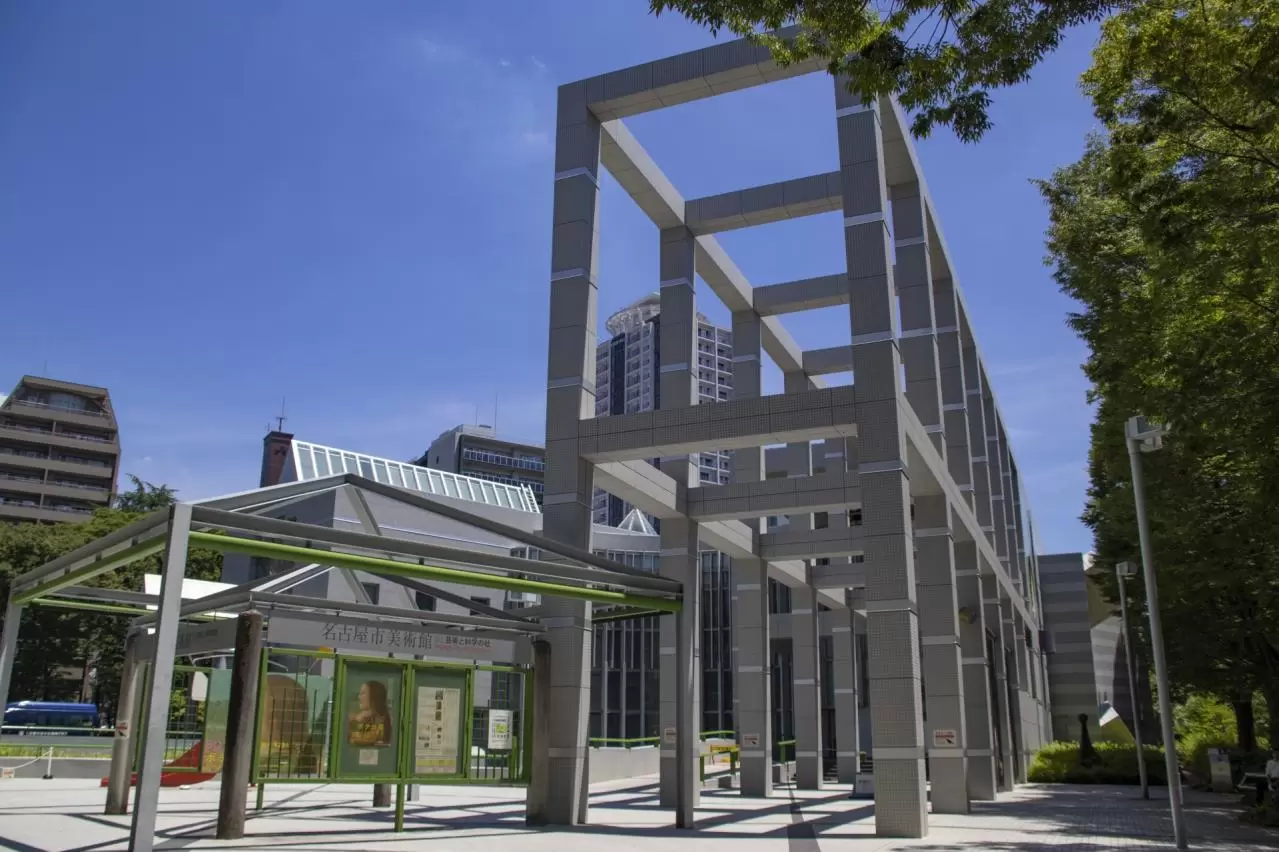
Nagoya City Art Museum
The museum boasts a diverse collection that ranges from works by local artists such as Setsuko Migishi, Seison Maeda, and Gyokudo Kawai to pieces from the École de Paris, the Mexican Renaissance, and contemporary art. Notably, it holds and displays works by internationally acclaimed artists such as Amedeo Modigliani, Frida Kahlo, and Shuji Nakagawa.
Visitors can enjoy the building itself as an artwork, with many creative elements incorporated into its design. The interior door frames and windows reflect Western architectural styles and Edo-period star charts, while outdoor arrangements feature landscapes of the Kiso River and the stone walls of Nagoya Castle.
The museum is also dedicated to educational outreach, offering extended hours on Friday evenings, lectures, concerts, guided tours, and programs for children. In this way, the Nagoya City Art Museum serves as a multifaceted facility that contributes to culture, education, and the local community, earning the affection of many.
Nagoya City Art Museum Movies


![名古屋ひとり旅。王道の観光スポット、絶品モーニング、ひつまぶしの名店など、行って大正解だったスポットを時系列順にお送りします。[前編1~6]](https://i.ytimg.com/vi/_gl5ZL4RI_s/mqdefault.jpg)
Basic Information
- Spot Name
- Nagoya City Art Museum
- Location
- 〒460-0008 2-17-25 Sakae, Naka Ward, Nagoya City, Aichi Prefecture, inside Shirakawa Park of Arts and Sciences
- Access
- From Fushimi Station on the Higashiyama and Tsurumai Lines, take Exit 5 and walk south for 8 minutes.
From Osu Kannon Station on the Tsurumai Line, take Exit 2 and walk north for 7 minutes.
From Yabacho Station on the Meijo Line, take Exit 4 and walk west for 10 minutes. - Parking
- No parking available.
- Business Hours
- 9:30 AM to 5:00 PM
(Fridays excluding April 29 and September 23 are open until 8:00 PM) - Regular Holiday
- Monday (If it falls on a holiday, it will be open and closed on the following weekday.) Exhibition change period ◎ New Year's holiday.
- Fees
- [Permanent Exhibition] General 300 yen / High school and university students 200 yen
Residents of Nagoya City, 65 years and older 100 yen / Free for middle school students and younger
* Please present a student ID or senior citizen's handbook. - Contact Information
- Phone Number:052-212-0001
- Official Website
Map
Detailed Information
Nagoya City Art Museum is located in Shirakawa Park in Fushimi, in the center of Nagoya. Surrounded by groves of zelkovas and other trees, it offers a quiet, verdant setting with a calm atmosphere well suited to appreciating art. It opened in April 1988 and has since played an important role as a cultural institution beloved by local residents.
1. Architectural Features — A Masterwork by Kisho Kurokawa
The Nagoya City Art Museum was designed by Kisho Kurokawa, a world-renowned architect from Aichi Prefecture. One of the building’s defining features is its original design, which blends elements of Japanese tradition with Western architecture.
The building is based on a north-south layout that follows the shape of the site, and by burying one floor underground, its height is kept low so that it harmonizes with the surrounding landscape of Shirakawa Park. The basement level houses the permanent galleries and storage rooms, while the above-ground areas contain the special exhibition rooms and lobby spaces.
A three-story atrium lobby and a gently sloping sunken garden help soften the sense of enclosure in the underground spaces, while natural light is carefully introduced throughout the building. In the special exhibition rooms on the first and second floors, top lights use fully blackout panels and milky-white panels that block ultraviolet rays, creating an exhibition environment suitable for international special exhibitions.
2. A Building That Tells a “Story”
The main theme of the Nagoya City Art Museum’s architecture is “the coexistence of Western and Japanese culture, and of history and the future.” Traditional Japanese motifs and Western architectural elements are skillfully woven into the building’s details.
Western architectural styles and Edo-period astronomical charts are cited in the interior doorframes and windows, and motifs reminiscent of the paulownia crest and a tea room are also incorporated. Outside, elements symbolizing the scenery of the Kiso River and the stone walls of Nagoya Castle add a sense of narrative to the entire structure.
From the floors and walls to the ceilings and the surrounding exterior spaces, numerous details invite visitors to “read” the building, offering new discoveries each time they visit. It can truly be said to be a highly regarded museum building that can be enjoyed as a work of art in its own right.
3. Collection Highlights — Four Pillars
The museum’s collection is organized around four main pillars. With more than 7,000 works in total, it is one of Japan’s most distinguished collections in both quality and quantity.
◆ Local Art
The museum broadly collects works by artists connected to Aichi Prefecture and Nagoya, including Setsuko Migishi, Shunso Maeda, Gyokudo Kawai, Morikazu Kumagai, and Kansuke Yamamoto. One of its major strengths is the ability to present the development of local art in a systematic way.
◆ École de Paris
Because Takanori Oguiss, who was from Inazawa in Aichi Prefecture, was active in Paris, the museum has built a strong collection of works by foreign artists who gathered in Paris in the first half of the 20th century, including Chagall, Kisling, Soutine, Pascin, Utrillo, and Modigliani.
Among them, Amedeo Modigliani’s Girl with Braids is one of the museum’s signature masterpieces.
◆ Mexican Renaissance
Against the background of Tamikichi Kitagawa, who was from Seto and worked in Mexico, and the sister-city relationship between Nagoya and Mexico City, the museum systematically collects modern Mexican art from the first half of the 20th century by artists such as Diego Rivera and José Clemente Orozco.
◆ Contemporary Art
The museum collects works by leading Japanese and international artists associated with conceptual art and minimal art, including Shusaku Arakawa, On Kawara, Tadaaki Kuwayama, Genpei Akasegawa, Tatsuo Kawaguchi, James Turrell, Frank Stella, and Lee Ufan.
4. Exhibition Structure and Sculptural Works
The exhibitions consist of two pillars: the permanent exhibition, centered on the museum’s collection, and special exhibitions focusing on specific artists or themes. The permanent exhibition is changed two or three times a year, with displays organized around seasonal themes drawn from the collection.
At the entrance, visitors are greeted by Alexander Calder’s sculpture Fáfnir Dragon II. In addition, contemporary sculptures by artists such as Isamu Noguchi and Antony Gormley are installed both inside and outside the museum, allowing visitors to experience art throughout the entire space.
5. Educational Outreach and a Museum Open to the Community
The Nagoya City Art Museum places great emphasis on educational and outreach activities. In addition to Friday night openings, it offers lectures, concerts, guided tours by curators, and “Children’s Museum” programs during summer vacation, creating opportunities for people of all ages to enjoy art.
As a museum open to the public, it is also highly appealing for providing not only opportunities for viewing art, but also a place for learning and exchange.
6. Summary of the Appeal of Nagoya City Art Museum
• A quiet location in harmony with the natural surroundings of Shirakawa Park
• A masterful building by architect Kisho Kurokawa that blends Japanese and Western elements
• Architecture as art, with the building itself telling a story
• A broad collection ranging from local art to École de Paris, Mexican Renaissance, and contemporary art
• More than 7,000 works in the collection and high-quality exhibitions
• A museum open to the community with extensive educational outreach programs
As an institution that embodies Nagoya’s cultural spirit, the Nagoya City Art Museum is one of Japan’s leading art museums, offering visitors the chance to experience art appreciation, learning, and architectural beauty all at once.
Aichi Tourist Attractions
View List
Tokugawa-en
Tokugawaen is a Japanese garden designed in the style of a pond and garden stroll, located at the site of the Ozoneshi residence built by Mitsutomo, the second lord ...

National Treasure Inuyama Castle
Inuyama Castle is one of five castles designated as national treasures in Japan, located in Inuyama City, Aichi Prefecture. Built during the Sengoku period by Oda No...

LEGOLAND® Japan
"LEGOLAND Japan" is an outdoor theme park that opened in 2017 at Knjyo Point in Nagoya City, targeting children aged 2 to 12 and their families. This park is the eig...

Noritake Garden
"Noritake no Mori" is a cultural complex created in Nagoya City to commemorate the 100th anniversary of the ceramics manufacturer "Noritake." Noritake started in 190...

Osu Kannon (Hosho-in)
Osu Kannon (Hōshō-in) is one of Japan's three great Kannon temples, located in the heart of Nagoya City. Its formal name is Kitano-san Shinpukuji Hōshō-in, with its ...

Nagoya Castle
Nagoya Castle is an important place in Japan's history and culture, and it is considered a symbol of Nagoya City. Construction of the castle began in 1610 (the 15th ...

Laguna Ten Bosch
Laguna Ten Bosch is a Japanese integrated resort located in the naturally rich Mikawa Bay. It features the theme park "Lagunasia," shopping and dining facilities at ...

Nagoya City Science Museum
Nagoya City Science Museum is located in Nagoya, Aichi Prefecture, with the concept of "See, Touch, and Verify." It opened in 1962, commemorating the 70th anniversar...