Kanda Matsuri
Kanda Matsuri Movies


Basic Information
- Spot Name
- Kanda Matsuri
- Location
- 〒101-0021 2-16-2 Sotokanda, Chiyoda-ku, Tokyo, Japan
- Access
- Ochanomizu Station | 5-minute walk
Shin-Ochanomizu Station | 5-minute walk
Akihabara Station | 7-minute walk - Parking
- Akihabara UDX Parking: Capacity of 800 vehicles
Akihabara Daibiru Parking: Capacity of 112 vehicles - Business Hours
- Early May
- Contact Information
- Phone Number:03-3254-0753
- Official Website
Map
Detailed Information
Kanda Matsuri is a grand traditional festival held at Kanda Myojin in Chiyoda City, Tokyo, and is counted among the Three Great Festivals of Edo. In the past, it was also called “Tenka Matsuri,” and as a prestigious festival viewed by the Tokugawa shogunate, it has long been beloved by the common people of Edo.
History and Origins
Kanda Myojin is said to have been founded in 730 (the 2nd year of the Tenpyo era), with a history dating back to the 8th century. Kanda Matsuri began as a Shinto rite praying for the repelling of epidemics and bountiful harvests. After Tokugawa Ieyasu entered Edo, Kanda Myojin was designated as the guardian deity of all Edo, and under the protection of the shogunate, the festival developed into an even more magnificent event.
Until the Genwa era, the main feature was a boat procession, but from the Enpo era onward, it came to be held alternately with Sanno Matsuri at Hie Shrine every other year, and the custom of holding the main festival in odd-numbered years continues to this day.
Structure of Kanda Matsuri
Kanda Matsuri is broadly divided into the grand “Main Festival,” held in odd-numbered years, and the “Shadow Festival,” held in between. During the Main Festival, the following major events take place, bringing vibrant color to central Tokyo.
Shinko-sai
Shinko-sai is a procession in which a sacred palanquin (ho-ren) carrying the deity of Kanda Myojin, along with portable shrines, tours the approximately 100 parish neighborhoods. The ho-ren is pulled by oxen, and together with people dressed in traditional attire, it makes its way through the center of Tokyo, including Kanda, Nihonbashi, Akihabara, Otemachi, and Marunouchi, purifying the city as it proceeds.
Joint Procession of Town Mikoshi into the Shrine
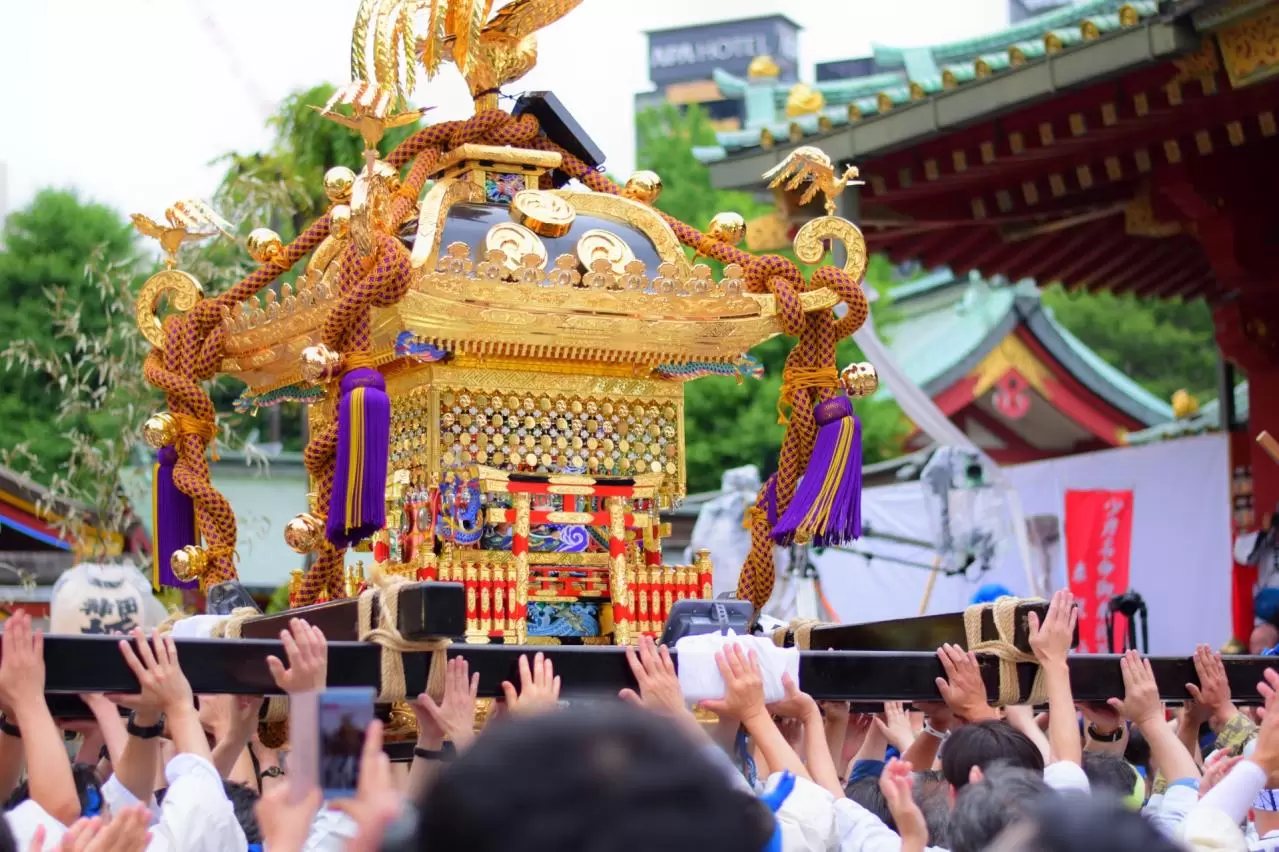
One of the most spectacular sights of Kanda Matsuri is the “Joint Procession into the Shrine,” in which the mikoshi of each parish neighborhood gather within the grounds of Kanda Myojin. Bearers carrying the mikoshi with vigor and pride fill the town with excitement and cheers.
Tsuke-Matsuri
Tsuke-matsuri is a parade in which floats, dancers, and participants in period costumes form a procession. Decorative floats based on folktales and historical figures, along with groups performing local traditional arts, appear and create a lively and festive atmosphere accompanied by the sound of festival music. In the climax, multiple processions merge, creating a magnificent scene like a living historical picture scroll.
Changes Since the Modern Era
With the advent of the Meiji period, Kanda Myojin was renamed Kanda Shrine. In the 1890s, many floats appeared, and the festival was held on a scale no less grand than in the Edo period. However, as urban modernization progressed, the stringing of power lines and changing traffic conditions made float processions increasingly difficult, and they gradually came to be preserved within each neighborhood instead.
In the Taisho period, the festival took the form of a “mikoshi procession festival,” and town mikoshi were created for each parish neighborhood and carried around the district. In the Showa period, the name of the festival was changed to “Shinko-sai,” and in 1952 a newly made ho-ren was pulled by oxen in procession, symbolizing the revival of Kanda Matsuri after the war.
From the 1970s onward, the timing of Shinko-sai was adjusted, and it is now firmly established as taking place on a Saturday in mid-May. In 1975, the Nino-miya mikoshi dedicated by Mitsukoshi was added to the procession, and in 1987 the newly made Sanno-miya ho-ren began to participate as well.
Revival Since the Heisei Era and Its Modern Form
Since the beginning of the Heisei era, further revival and enhancement of the festival has continued. Special participants such as the “Masakado warrior procession” and the “Soma Nomaoi horse-mounted warriors” have joined, and the recreation of Edo-period fire brigade processions and the restoration of floats have also been realized. In 2003, a boat procession inspired by older styles was revived by the Higashi-Nihonbashi 2-chome neighborhood association, marking an effort to return to the festival’s origins.
In addition, promotional activities using modern technologies—such as live streaming of the festival over the internet (including Kanda Matsuri.ch) and multilingual guidance—have drawn attention both in Japan and overseas.
The Appeal of Kanda Matsuri Today
Today’s Kanda Matsuri is one of Tokyo’s representative festivals, combining more than a thousand years of history with modern technology. The splendid mikoshi and floats, along with the parades driven by the passion and unity of local residents, convey the essence of Edo culture to the present day.
During the festival period, a variety of food stalls and events are held within the grounds of Kanda Myojin and the surrounding area, making it an enjoyable place for people of all ages, from children to adults. Set in the Kanda, Nihonbashi, and Akihabara areas, where Tokyo’s history and modernity intersect, Kanda Matsuri is a source of local pride and a precious cultural heritage of Tokyo.
Tokyo Tourist Attractions
View List

Mitaka no Mori Ghibli Museum
The Ghibli Museum, Mitaka is situated within Inokashira Park in Mitaka City, Tokyo, and offers a chance to experience the world of Studio Ghibli. Opened in 2001 unde...

Tokyo National Museum
Founded in 1872, the Tokyo National Museum is the oldest museum in Japan, focusing on Japanese and Asian art and archaeology. Located in Ueno Park, Taito-ku, Tokyo, ...

Nedzu Museum
The Nezu Museum was established in 1941 (Showa 16) to preserve and display ancient Japanese and East Asian art collected by businessman Kaichiro Nezu (1860-1940). Th...

Shibuya Scramble Crossing
Shibuya Scramble Crossing is one of the iconic landmarks of Tokyo, where more than 1,000 people are said to cross at once during peak hours. This intersection, leadi...

Ryogoku Kokugikan
Ryogoku Kokugikan is the "home of sumo," where the Grand Sumo Tournament is held three times a year. This multipurpose hall, which can accommodate up to 10,000 peopl...

Hibiya Park
Hibiya Park opened in 1903 as Japan's first modern urban park, incorporating Western-style design while also integrating elements of Japanese aesthetics. It was desi...

Tokyo Skytree®
Tokyo Skytree® is the tallest freestanding broadcasting tower in the world, located in Sumida, Tokyo. Since its opening in 2012, it has attracted many tourists as a ...