Traces of Kubota Castle
Explore castle-era sights, including the Osumi Yagura turret and the front gate.
AI Summary
This is an AI-generated summary. Please check the official information for opening hours, fees, and closed days.
A short walk from Akita Station, this park offers an easy way to enjoy local history and seasonal scenery.
Built on the former site of Kubota Castle, Senshu Park combines Akita domain history with the calm scenery of a Japanese garden. Highlights include the Osumi Yagura turret, the front gate, and a museum. Cherry blossoms in spring and autumn foliage are also draws, and its location near the station makes it a good choice for a short stroll.
Explore castle-era sights, including the Osumi Yagura turret and the front gate.
The park changes with the seasons, with cherry blossoms and autumn foliage among its highlights.
Within walking distance of Akita Station, the park is easy to fit into your itinerary.
Walk from Akita Station and explore the park, stopping at the Osumi Yagura turret and museum before looping past the pond and open areas.
Senshū Park is a beautiful park in the center of Akita City, Akita Prefecture, conveniently located about a 10-minute walk from Akita Station. It is a place where nature and history blend harmoniously. The park stands on the site of Kubota Castle, built in 1603 (Keichō 8) by Satake Yoshinobu, the first lord of the Akita Domain, after he was transferred from Hitachi Province in 1602 (Keichō 7) following the Battle of Sekigahara. Today, the former castle grounds have been developed as a modern Japanese garden and serve as a relaxing retreat for both residents and visitors.
Historical Background
Kubota Castle was a “hirayama-style” castle, built using the natural terrain without a keep. It was characterized by a defensive structure of moats and earthworks with little use of stone walls. The absence of a tenshu is said to have been due to considerations for the Tokugawa shogunate and financial constraints. Even today, a water moat remains in the park, allowing visitors to sense the atmosphere of the past. Kubota Castle served as the residence of the Satake clan, lords of the Akita Domain, for 12 generations until the return of the domains and lands to the emperor in 1869 (Meiji 2).
In 1896 (Meiji 29), the former site of Kubota Castle was developed as “Senshū-en” by Nagaoka Yasuhira, known as a pioneer of modern Japanese park design. The name was given by the Sinologist Kanō Ryōchi, combining the “aki” of Akita with “Senshū,” meaning “long-lasting and eternal.”
Highlights and Facilities
Senshū Park is dotted with historic structures and cultural facilities that convey the history of the Akita Domain, offering visitors a rich historical experience.
Kubota Castle Osumi Turret
Recreated on a hill on the north side of the main compound, the Osumi Turret once played an important role as a lookout and armory. Today, its interior has been developed as an observation facility, and it is beloved as a symbol of the park for its panoramic views of Akita City and the park’s natural scenery.
Kubota Castle Main Gate
The Main Gate, which once served as the principal gate to the main compound, has been rebuilt as a two-story wooden turret gate. In the surrounding area stood buildings such as the “Omono-gashira Gobansho,” which was responsible for guarding the gate, and the “Gobantō-goyakusho,” mentioned in historical records, preserving the atmosphere of the castle’s former defensive center.
Omono-gashira Gobansho
This is the only surviving building from the domain era within Kubota Castle. It was used as the office of the omono-gashira, or the leader of a foot soldier unit. Since it handled gate operations, security, and fire response, it offers insight into the management of the castle town at the time.
Yojiro Inari Shrine
This shrine is based on a legend about a fox that lost its home during the construction of Kubota Castle and asked Satake Yoshinobu to let it serve him as “Yojiro, guardian of the tea garden.” The fox is said to have been remarkably swift, able to travel between Akita and Edo in just six days, but it eventually died out of jealousy from fellow courier runners. The shrine was built to memorialize its spirit.
Akita City Satake Historical Museum
This cultural facility exhibits valuable materials related to the illustrious Satake clan, which traces its lineage to the Minamoto family. Visitors can learn in depth about the politics and daily life of the Akita Domain and the development of the Kubota castle town. Armor, historical documents, and maps are on permanent display.
Ninomaru Plaza
A grassy plaza reached by climbing the slope from Nakato-bashi Street, this historic space is said to have been where the domain lord viewed noh performances and town dances. The park’s shop sells souvenirs and seasonal soft-serve ice cream, making it an ideal stop during a stroll.
Sen’an
A traditional tea room with the refined atmosphere of Japanese architecture, used for tea ceremonies and cultural events. In this quiet space, visitors can experience the depth of Japanese culture.
Kogetsu Pond
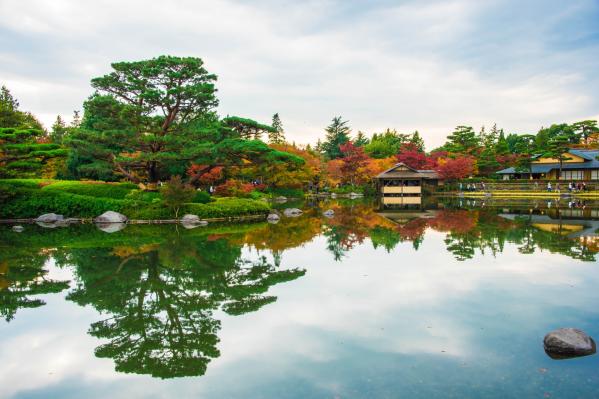
Located at the center of the Japanese garden, this pond harmonizes with the surrounding flowers, trees, and greenery, reflecting the scenery of each season. It is one of the most picturesque spots along the walking paths.
Seasonal Nature
Senshū Park is also known for the beauty of its nature, which changes with each of the four seasons.
Spring: Around 700 Somei Yoshino cherry trees bloom in full splendor, and the park is bustling with hanami visitors.
Early Summer: Azaleas and wisteria reach their peak around late May, while early summer flowers such as Japanese irises, Japanese water irises, and irises also color the park.
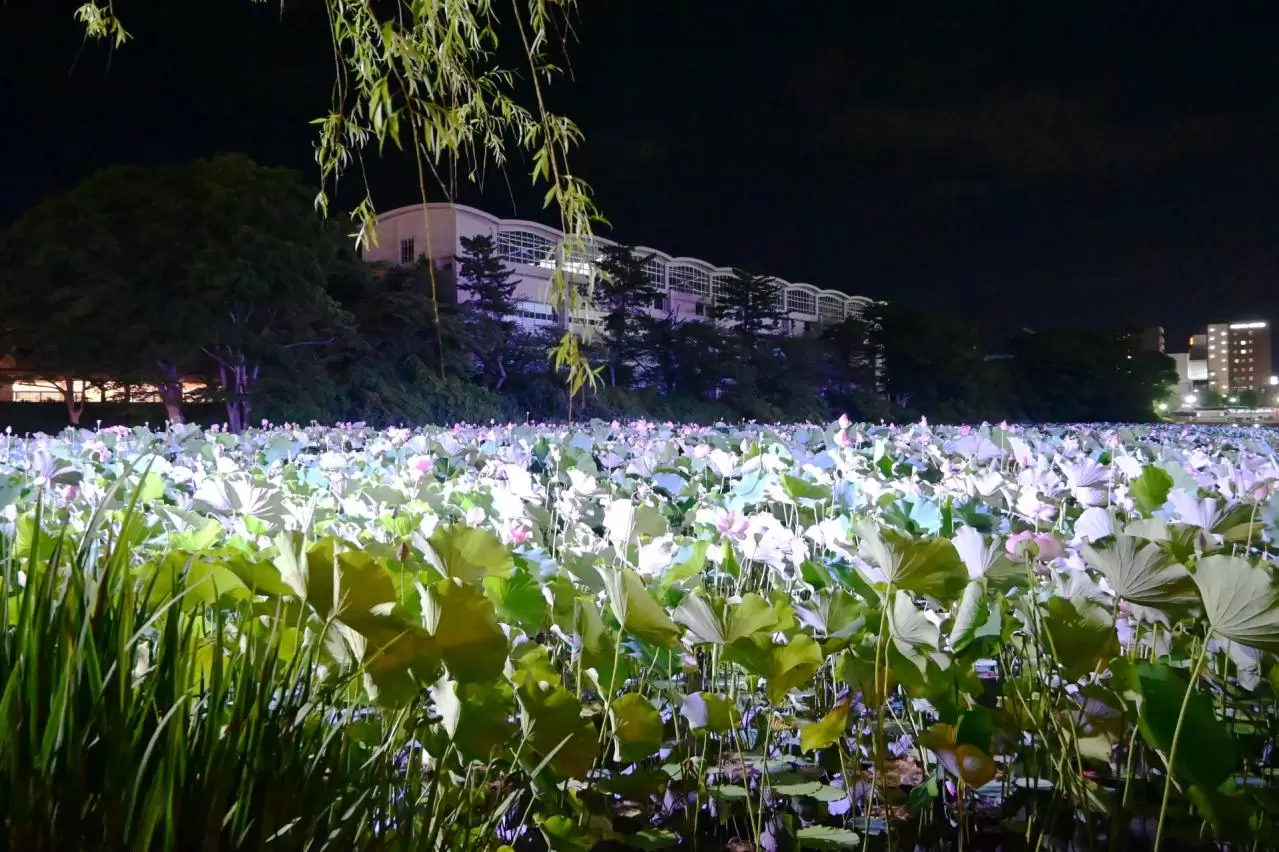
Summer: Lotus blossoms blooming in the moat bring a refreshing, elegant atmosphere.
Autumn: From mid-October to early November, maples and ginkgo trees turn beautifully red and yellow, attracting many visitors as a famous spot for viewing autumn leaves.
These natural sights can be enjoyed throughout the year while walking the park’s scenic paths.
Nearby Cultural and Educational Facilities
Many facilities where visitors can experience history and culture are located around Senshū Park.
Akita Museum of Art
Akita City Central Library “Meitokukan”
Akita City Cultural Creation Center
Akita Cultural Facility “Matsushita” (a cultural facility where you can meet Akita maiko)
Akita Dog Interaction Corner in Senshū Park
These facilities offer opportunities to appreciate art, learn, and encounter local culture, making the area highly valuable not only for sightseeing but also for cultural experiences.
With its historical background as the site of Kubota Castle, Senshū Park is a charming place where the beauty of the four seasons and cultural facilities blend together as a modern park. While tracing the lingering presence of the feudal era, visitors can enjoy beautiful scenery in a peaceful setting. This park is perfect not only for history enthusiasts but also for strolling with family and friends. Though located in the center of Akita, Senshū Park offers a calm escape from everyday life and a place where time seems to pass more gently. Why not visit Senshū Park and experience its charm for yourself?
Hachibodai is a breathtaking spot where you can enjoy a panoramic view of the magnificent scenery from the highlands of the Oga Peninsula at an elevation of 180 mete...
The Akita Port Tower Selion, located at the Michi no Eki (Roadside Station) Akita Port, is a symbol of Akita City. From the observation deck at 100 meters above grou...
Located in Akita Prefecture, Lake Tazawa is known as the deepest lake in Japan, with a depth of 423.4 meters. The surface of the lake changes into a variety of color...
The "Akita Inu Museum," located in Odate City, Akita Prefecture, is a facility dedicated to the preservation of Akita dogs and the promotion of their charm. The muse...
Hōkaeri Valley is a beautiful 10-kilometer-long gorge that stretches along the midstream of the Tamagawa River, which flows between Lake Tazawa and Kakunodate. It ha...
The "Namahage Museum" is a facility located in Oga City, Akita Prefecture, focusing on "Namahage of Oga," which has been registered as a UNESCO Intangible Cultural H...
Tamagawa Onsen is one of Japan's premier hot springs, located in the mountainous area of Senboku City, Akita Prefecture. This onsen boasts two "number one" features....
The Akita Museum of Art, designed by the renowned architect Tadao Ando, features a tranquil and simple space. Inside the museum, various works by different artists a...