Shiseki Takamatsu Castle Ruins and Tamamo Park
Shiseki Takamatsu Castle Ruins and Tamamo Park Movies


Basic Information
- Spot Name
- Shiseki Takamatsu Castle Ruins and Tamamo Park
- Location
- 〒760-0030 2-1 Tamamo-cho, Takamatsu City, Kagawa Prefecture
- Access
- A 5-minute walk from JR Takamatsu Station.
- Parking
- 57 standard cars
- Business Hours
- The East Gate is open from 7:00 AM to 6:00 PM (from October to March of the following year, it is open from 8:30 AM to 5:00 PM), and the West Gate is open from sunrise to sunset.
- Regular Holiday
- December 29th to December 31st
- Fees
- Adults (16 years and older) 200 yen (Group of 20 or more 140 yen) Children (6 years and older, under 16) 100 yen (Group 70 yen) Free for those under 6 years old.
- Contact Information
- Phone Number:087-851-1521
- Official Website
Map
Detailed Information
Takamatsu Castle Ruins Historic Site and Tamamo Park is a historic park located in central Takamatsu City, Kagawa Prefecture. It was developed around the ruins of Takamatsu Castle, once the residence of the Ikoma family, who ruled Sanuki Province, and the Matsudaira family, lords of the Takamatsu Domain. Built facing the Seto Inland Sea, Takamatsu Castle was a seaside castle and is also known by its nickname, Tamamo Castle. Today, it is preserved as a nationally designated historic site and is enjoyed by residents and visitors as a park where they can experience history and nature.
The name “Tamamo” is said to derive from a poem in the Man’yoshu anthology in which the poet Kakinomoto no Hitomaro described Sanuki with the phrase “Tamamo yoshi.” Since ancient times, the sea around this area has been known as Tamamo-no-Ura, and Tamamo Park was named after this historic place-name.
## One of Japan’s Three Great Water Castles
Takamatsu Castle is known as one of the “Three Great Water Castles of Japan,” along with Imabari Castle in Ehime Prefecture and Nakatsu Castle in Oita Prefecture. Its most distinctive feature is its rare structure, in which seawater from the Seto Inland Sea was drawn directly into the castle moats.
When Takamatsu Castle was first built, it faced the sea, and the moats were connected to it. The seawater strengthened the castle’s defenses and was also used for transporting goods and people by boat. Even today, seawater from the Seto Inland Sea flows into the moats, where visitors can see marine life such as red sea bream and mullet swimming.
Because of this structure, Takamatsu Castle was more than simply a fortress. It also played an important role as a center for military affairs, transportation, and the movement of supplies.
## The History of Takamatsu Castle
Construction of Takamatsu Castle began in 1588, when Ikoma Chikamasa became the lord of Sanuki Province. A warrior who had served Toyotomi Hideyoshi, Ikoma Chikamasa built the castle as a base for governing Sanuki.
The Ikoma family ruled Takamatsu Castle for four generations, but in 1640, the family was dispossessed following a succession dispute.
In 1642, Matsudaira Yorishige, a member of the Mito branch of the Tokugawa family, entered the domain as lord of Takamatsu. From that time until the Meiji Restoration, the Matsudaira family governed the Takamatsu Domain for eleven generations.
Takamatsu Castle developed as the political, economic, and cultural center of Sanuki Province, and the castle town prospered greatly. However, during the Meiji period, the castle lost its function following the Castle Abolition Ordinance, and many of its buildings were demolished.
Today, the site is preserved as castle ruins and was designated a national historic site in 1955.
## Important Cultural Properties Conveying the Castle’s Former Glory
The keep of Takamatsu Castle was dismantled in 1884 because of its deterioration. It is said to have once been one of the largest castle towers in Shikoku, but today only its stone foundation remains.
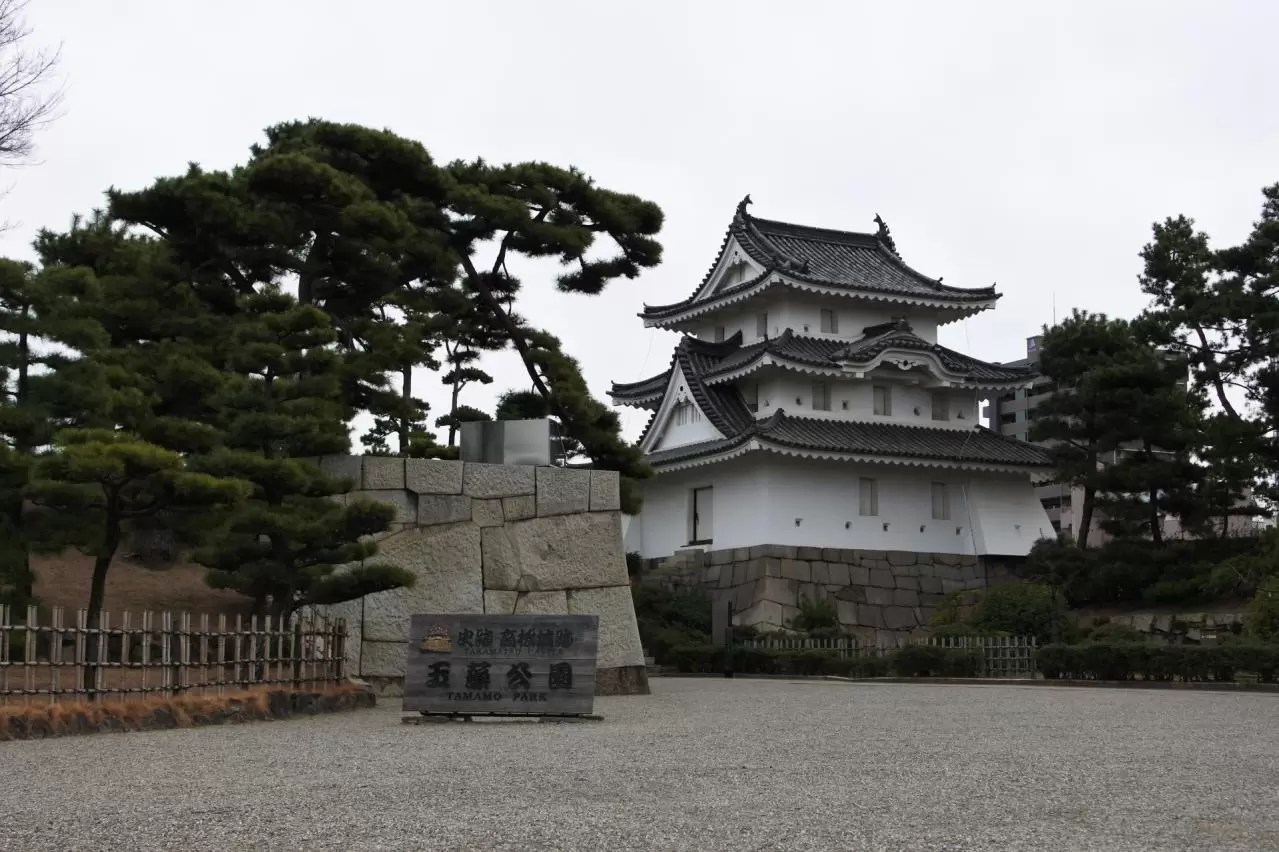
Within the park, several Edo-period structures still survive: the Tsukimi Yagura Turret, Mizute Gomon Gate, Watari Yagura Turret, and Ushitora Yagura Turret. All of them have been designated Important Cultural Properties of Japan. Hiunkaku, built during the Taisho period, is also designated as an Important Cultural Property.
### Tsukimi Yagura Turret
This turret is one of the most representative structures of Takamatsu Castle and once served to monitor the sea to the north. Although its name means “Moon-Viewing Turret,” it is also said to have originally been called Tsukimi Yagura, meaning a turret for watching ships entering and leaving by sea.
Its beautiful appearance, set against white walls and the sea, is one of the views that symbolizes Takamatsu Castle.
### Mizute Gomon Gate
This gate faces the sea and allowed people to enter and leave the castle by boat without disembarking. It is a valuable surviving structure that conveys the former character of Takamatsu Castle as a seaside castle.
### Watari Yagura Turret
This building connects the Tsukimi Yagura Turret and Mizute Gomon Gate and once played an important role as a defensive facility.
### Ushitora Yagura Turret
Located in the northeastern part of Takamatsu Castle, this turret was built at a key position for defending the fortress. Its imposing form atop massive stone walls is particularly impressive.
## Hiunkaku and Its Scenic Garden
One of the park’s major highlights is Hiunkaku.
The present Hiunkaku was built in 1917 as a reception hall for the former lords of the Takamatsu Domain, the Matsudaira family. It is designated an Important Cultural Property of Japan. The building conveys the beauty of traditional Japanese architecture, with an elegant grand hall and spaces featuring shoin-style design still preserved inside.
Hiunkaku continues to be used today for a variety of cultural events, including tea ceremonies, exhibitions, and concerts, despite being a historic building.
The garden of Hiunkaku has also been designated a Place of Scenic Beauty. Designed as a stroll garden centered around a pond, it creates beautiful scenery with plants and stone arrangements that change with the seasons.
## Castle Boat Rides and Feeding the Sea Bream
Tamamo Park offers popular activity programs unique to Takamatsu Castle.
### Castle Boat Experience
Visitors can take a ride around the inner moat in a traditional Japanese-style wooden boat and view the ruins of Takamatsu Castle from the water. The experience is popular with tourists because it allows them to observe the stone walls and turrets from angles that are normally impossible to see.
### Feeding the Sea Bream
Many red sea bream swim in the seawater moat, and visitors can enjoy feeding them. Seeing sea bream swimming in a castle moat is rare throughout Japan and is one of the unique highlights of Takamatsu Castle.
This experience is also popularly known by the auspicious name “Taigan Joju,” a pun meaning the fulfillment of wishes for success at the castle.
## Sakuragomon Gate and the Keep Foundation
Sakuragomon Gate, reconstructed in recent years, is one of the representative large gates of Takamatsu Castle and once served as an important main entrance to the secondary bailey. Reconstructed based on materials from the Edo period, it allows visitors to appreciate the former grandeur of Takamatsu Castle.
The foundation on which the castle keep once stood also remains. From atop the stone walls, visitors can enjoy views of the Seto Inland Sea and the area around Takamatsu Port. It is a popular spot where visitors can imagine the castle tower that once rose here and was said to be one of the largest in Shikoku.
## Seasonal Attractions
Tamamo Park offers not only historic value but also the beauty of nature throughout the seasons.
In spring, the cherry trees in the park bloom beautifully, attracting many visitors for hanami flower viewing. In early summer, the fresh greenery comes into full view, while a chrysanthemum exhibition is held in autumn. Various seasonal events take place throughout the year. In winter, visitors can enjoy the quiet atmosphere of the castle ruins, making it possible to experience a different charm in every season.
## Tamamo Park Today
Today, Tamamo Park conveys the history of Takamatsu Castle as a nationally designated historic site and is one of Takamatsu City’s leading tourist attractions. With its seawater-filled moats, turrets and gates designated as Important Cultural Properties, scenic garden, and Hiunkaku, the park preserves the character of one of Japan’s finest seaside castles.
In addition to strolling through the historic site, visitors can enjoy hands-on tourism experiences such as castle boat rides and feeding the sea bream, making it an appealing destination for people of all ages. It is one of Kagawa Prefecture’s most representative historic and cultural treasures and a place well worth visiting when traveling to Takamatsu.
Kagawa Tourist Attractions
View List
Ritsurin Garden
Ritsurin Park is a vast daimyo garden located in Takamatsu City, and its charm is immeasurable. The flat area alone spans 16.2 hectares, and when including Mount Shi...

Angel Road
Angel Road is a romantic spot located on Shodoshima Island, featuring a sandy path that only appears during low tide, twice a day. This path connects four islands, a...

Kotohira Shrine
Konpira Shrine, commonly known as "Sanuki Konpira-san," is a sacred place located on the slopes of Mount Zoto. This shrine is revered as the deity of the sea and is ...

Kankakei Ropeway
The Kankakei Ropeway is a cable car that leads to the summit of Kankakei, located within the Setonaikai National Park. Kankakei is counted among Japan's three great ...

Marugame Castle
Marugame Castle, boasting a history of 400 years, is a renowned stone castle located in Marugame City, Kagawa Prefecture. Built on Kameyama Mountain at an elevation ...

Michi-no-Eki "Shodoshima Olive Park"
The "Shodoshima Olive Park" roadside station is located on a small hill that offers a panoramic view of the Seto Inland Sea. It is a Mediterranean-themed spot featur...

Seto Ohashi Memorial Park
Seto Ohashi Memorial Park is a seaside park located in an ideal spot with a close view of the Seto Ohashi Bridge. Within the park, there is a memorial hall where vis...

Chichibu Shore
"Chichibugahama" in Mitoyo City, Kagawa Prefecture, is a seaside resort known for its approximately 1 km long beach and beautiful sunsets. During low tide, the water...