Kumano Nachi Taisha
Kumano Nachi Taisha Movies


Basic Information
- Spot Name
- Kumano Nachi Taisha
- Location
- 〒649-5301 1 Nachiyama, Nachikatsuura Town, Higashimuro District, Wakayama Prefecture
- Access
- From JR Kinokuni Line Kii-Katsuura Station, take the Kumano Transportation bus to Nachiyama for 25 minutes. Get off at the last stop and walk for 15 minutes.
- Parking
- Parking available.
- Business Hours
- 7:00 AM to 4:30 PM (Last entry at 4:45 PM), Treasure Hall is open from 8:30 AM to 4:00 PM.
- Regular Holiday
- None
- Fees
- 300 yen for adults (Treasure Hall)
- Contact Information
- Phone Number: 0735-55-0321
- Official Website
Map
Detailed Information
Kumano Nachi Taisha is a Shinto shrine situated at an elevation of approximately 500 meters on the slopes of Mount Nachi in Nachikatsuura, Wakayama Prefecture. Along with Kumano Hongu Taisha and Kumano Hayatama Taisha, it has long been revered as one of the “Three Grand Shrines of Kumano.” It is regarded as the spiritual center of the Kumano faith, which is practiced at several thousand Kumano shrines throughout Japan, and attracts deep devotion as an important sacred site.
■ Overview and History
The origins of Kumano Nachi Taisha lie in nature worship, in which Nachi Falls was revered as a deity. According to legend, in 662 BCE, Emperor Jimmu—also known as Kamu-yamato-Iware-hiko—enshrined Nachi Falls as a deity. Later, in the fifth year of Emperor Nintoku’s reign (317), shrine buildings were established at the present location, where the deity of the falls and the deities of Kumano came to be worshipped together.
With a history spanning approximately 1,700 years since its foundation, the shrine has developed over the centuries as a center of the Kumano faith. In 2004, it was registered as part of the UNESCO World Heritage Site “Sacred Sites and Pilgrimage Routes in the Kii Mountain Range,” and the main shrine buildings have been designated Important Cultural Properties of Japan.
■ Principal Deity and Beliefs
The principal deity is **Kumano-Fusumi-no-Okami (also known as Izanami-no-Mikoto)**, a deity who governs the creation and nurturing of all things. Through this divine virtue, the shrine is believed to grant blessings for finding love, good health, and the fulfillment of various wishes.
The deity is particularly known as the deity of “connection,” and Kumano Nachi Taisha is also called “Musubi-no-Miya,” or the Shrine of Connection. It is widely revered not only as a place to pray for bonds between people, but also for the fulfillment of various wishes related to work and life.
■ Features of the Shrine Grounds
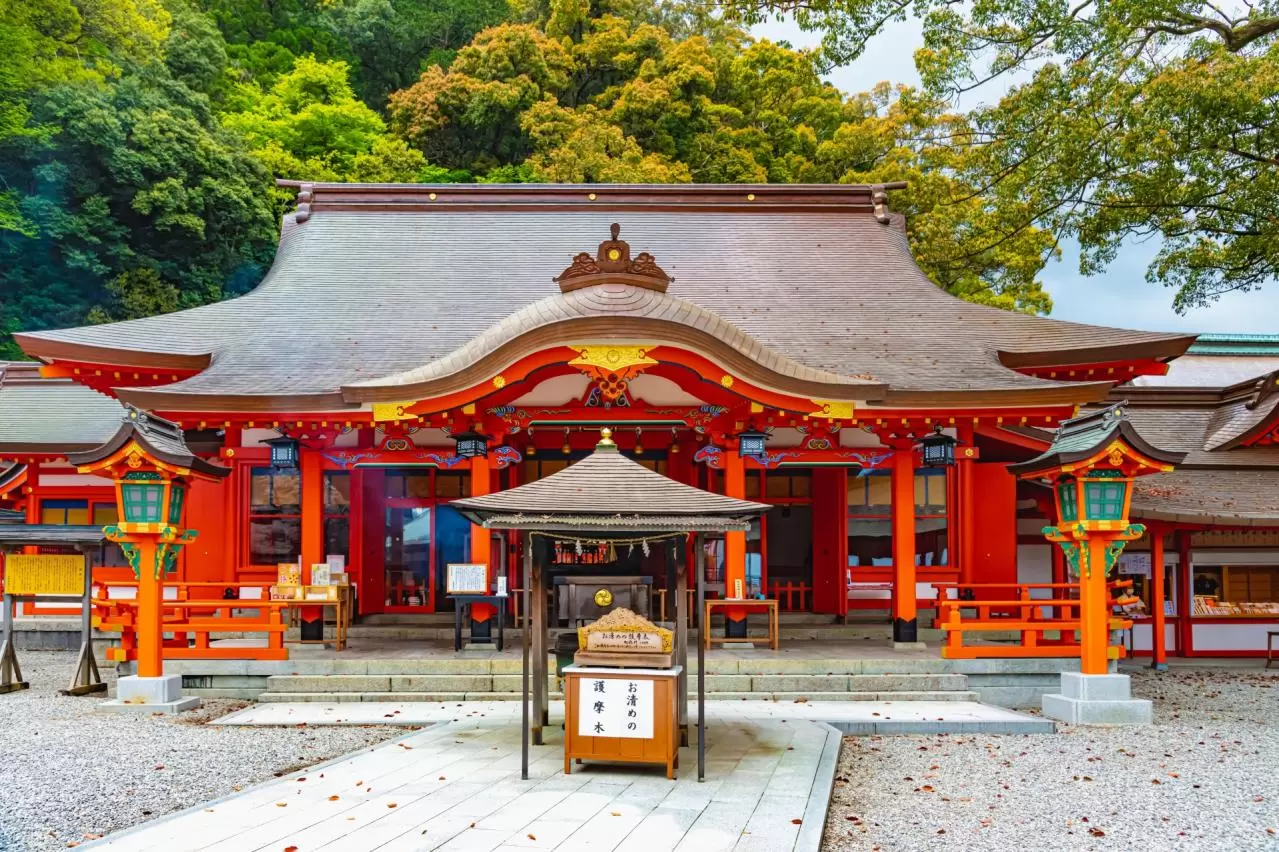
Visitors reach the shrine by climbing approximately 460–470 stone steps. At the top, six vermilion-lacquered shrine buildings stand out against the green mountains, creating a solemn atmosphere.
The main highlights include:
・**The Main Shrine Buildings (six buildings):** Each enshrines a different deity, together forming a sacred space.
・**Mikakurehiko Shrine:** A shrine dedicated to Yatagarasu, the three-legged crow revered as a deity who provides guidance.
・**Karasu-ishi:** A stone said to be the transformed form of Yatagarasu, who guided Emperor Jimmu.
・**The Great Camphor Tree (approximately 850 years old):** Its trunk is hollow, and visitors can pass through it in a ritual known as “going through the womb” to pray for good health and protection from illness.
・**The Nagi Tree:** A sacred tree regarded as a symbol of safety and good health.
■ Relationship with Nachi Falls
One of the symbols of Kumano Nachi Taisha is the adjacent Nachi Falls. With a drop of 133 meters, it is one of Japan’s three most famous waterfalls and has been worshipped as a deity itself since ancient times.
The waterfall is the sacred object of worship at the auxiliary shrine, Hiro Shrine, which has no shrine building; instead, nature itself is worshipped. It embodies the nature worship that lies at the origin of the Kumano faith.
■ Relationship with Nachisan Seiganto-ji Temple
Immediately next to Kumano Nachi Taisha stands Nachisan Seiganto-ji Temple. It is the first temple on the Saigoku Kannon Pilgrimage, a pilgrimage route consisting of 33 sacred sites, and in the past it functioned as part of a unified sacred site under the tradition of syncretism between Shinto and Buddhism. Although it was separated into its present form during the Meiji period as part of the separation of Shinto and Buddhism, the area continues to attract many visitors as an integrated space of worship.
The view of the three-story pagoda and Nachi Falls is especially famous and is considered one of Japan’s most spectacular landscapes.
■ The Kumano Kodo and Pilgrimage
Known as an approach to Kumano Nachi Taisha, Daimon-zaka is one of the routes along the Kumano Kodo pilgrimage trails. This approximately 1.3-kilometer path, surrounded by moss-covered stone steps and cedar trees, is a popular route where visitors can experience the footsteps of pilgrims from long ago.
Highlights along the way include:
・**Meoto-sugi:** A pair of cedar trees approximately 800 years old
・**Furika-se Bridge:** The entrance to the sacred area
・**Daimon-zaka Teahouse:** Offers experiences such as trying on Heian-period costumes
Although relatively short, the route provides a concentrated experience of the charms of the Kumano Kodo.
■ Annual Events and Nature
Various events are held at Kumano Nachi Taisha amid the beauty of nature throughout the seasons.
・**Spring (late March to April):** Weeping cherry trees bloom in abundance, creating an elegant landscape.
・**Summer (July):** Nachi no Ogi Matsuri, or the Nachi Fire Festival, one of Japan’s three major fire festivals, is held. The O-taki-moto Shinto ritual, in which the approach to the shrine is purified with enormous torches, is a breathtaking spectacle.
■ Access and Surrounding Attractions
Even for visitors who have difficulty climbing the stone steps, the shrine is accessible by car or bus to a location nearby, making it convenient for anyone to visit. The surrounding area also offers many attractions, including Katsuura Onsen and Katsuura Fishing Port, which is renowned for its fresh Pacific bluefin tuna.
■ Conclusion
Kumano Nachi Taisha is one of Japan’s foremost sacred sites. Originating in nature worship, it developed over its long history into a center of the Kumano faith. The sacred area formed together with Nachi Falls and Seiganto-ji Temple allows visitors to experience both profound spirituality and the powerful presence of nature.
It is also a popular destination for those praying for love and for blessings at important turning points in life. The shrine is truly a special place where history, nature, and faith come together.
Wakayama Tourist Attractions
View List
Adventure World
Adventure World is a theme park that integrates a zoo, aquarium, and amusement park, themed around "Smile in Your Heart, Creating the Future Park." Visitors can expe...

Kumano Hongu Taisha
Kumano Hongu Taisha is one of the Kumano Sanzan (Kumano Hongu Taisha, Kumano Nachi Taisha, and Kumano Hayatama Taisha) and serves as the head shrine of all Kumano sh...

Toretore Ichiba Nanki Shirahama
Toretore Market in Nanki Shirahama is one of the largest seafood markets in Western Japan, managed by the local Kata Fishing Cooperative. As a result, you can find e...

Wakayama Castle
Wakayama Castle is an iconic castle that towers over Wakayama City, situated on Mount Torafusu. It was once referred to as "Oten su" in the Wakayama dialect. This ca...

Shirarahama Beach
Shirarahama is a beautiful beach extending about 620 meters, and it is one of the most famous beaches in the Kansai region. Its name comes from the pure white sandy ...

Senjōji Temple
Chinjoh-jiki is a scenic spot in Wakayama, characterized by its expansive rock formation located at an elevation of about 200 meters. The sloping white rock face, wh...

Nachi Falls
Nachi Falls is a famous spot in Wakayama, recognized as one of Japan's three great waterfalls, boasting a height of 133 meters, a width of 13 meters at the mouth, an...

Kongōbu-ji
Kongōb номерji is the headquarters of the Kōyasan Shingon sect, and is a sacred site of Japanese Buddhism established by the Great Teacher Kūkai in the early Heian p...